
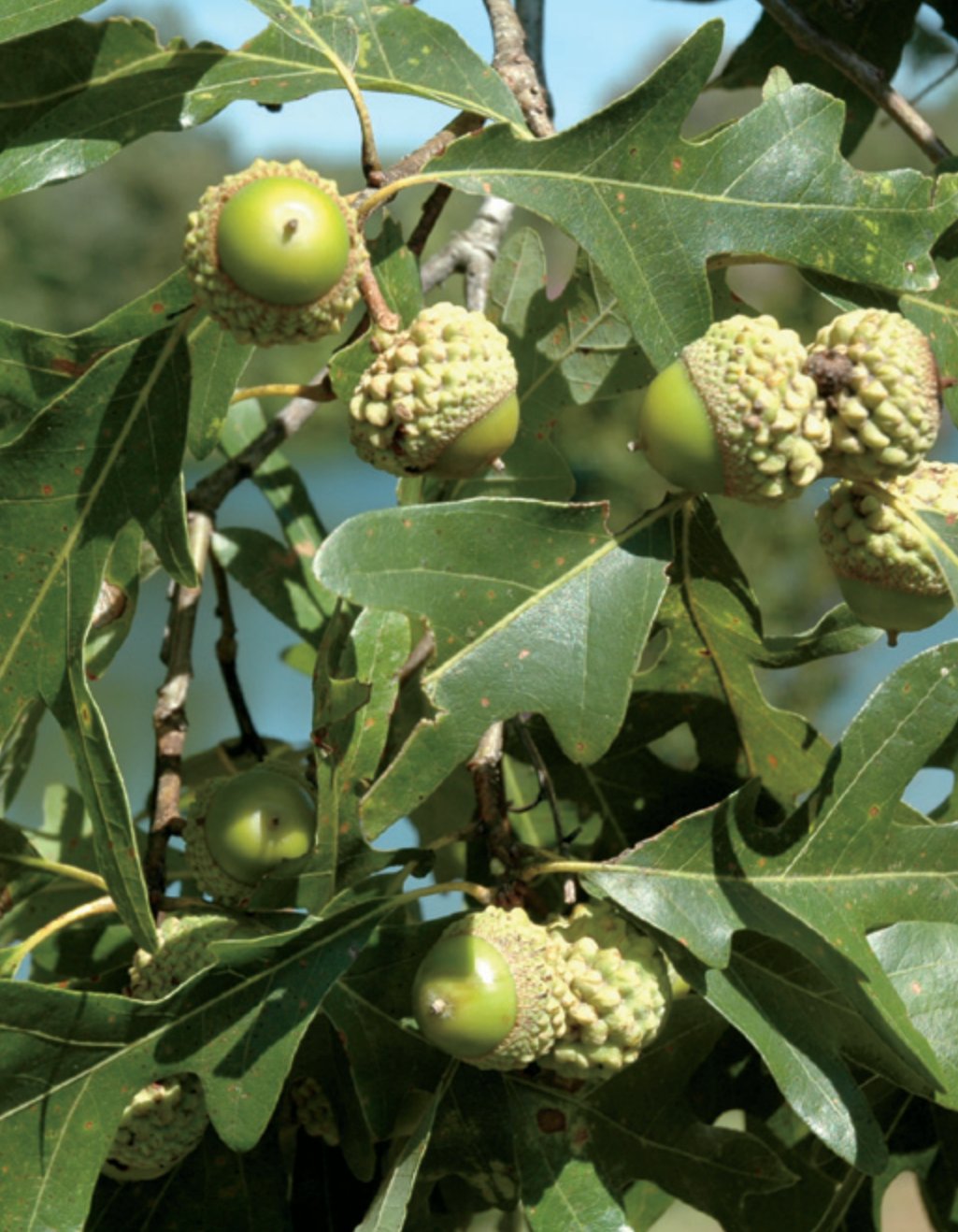
Commonly, recommendations are provided landowners to fertilize oak trees for increased acorn production. Some even claim fertilization leads to sweeter acorns. For many people, this may seem intuitive. However, there are no data to support such claims. Many factors affect acorn production, and they should be considered carefully before spending time and money on a fertilization program that may produce no effect whatsoever.
Natural variability and genetics
Mast crops are extremely variable. In fact, among white oaks, data show there is, on average, only one or two good mast years out of five. Variability in acorn production is attributable to poor pollination following continuous rain and/or insufficient wind, late frosts, and drought. Later in the season, acorn weevil depredation can also be a significant factor in sound acorn availability.
Among individual oak trees, there are good producers, moderate producers, and poor producers. There are also genetic differences in reproductive maturity among individuals. During any given year, the good producers will produce the majority of the acorn crop.
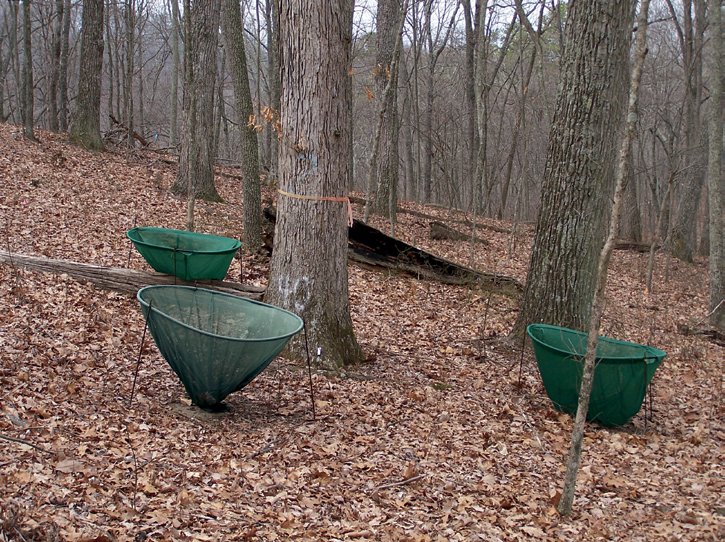
In 2006, two of my graduate students (Michael McCord and Marcus Lashley) identified 120 white oaks in east TN for acorn production sampling. Acorn production per square foot of crown coverage averaged 0.06 acorns in 2006, 0.70 acorns in 2007, and 5.70 acorns in 2008. Obviously, 2008 was a bumper acorn year. During all three years, however, there were trees that never produced an acorn, even in 2008. Among individual trees, 25% of the white oaks produced 90%, 87%, and 67% of the acorns, respectively, 2006 – 2008. There were many trees that did not produce any acorns 2 out of 3 years. Overall, approximately 33% of the trees qualified as good producers, 19% moderate producers, and 48% poor producers. That means nearly half the white oaks out in the woods produce very few acorns, or none at all!
Fertilizer requirements
In production agriculture, there are very specific fertilizer recommendations with regard to various soil conditions for each crop grown. What are those needs for oaks in relation to acorn production? No one knows. What is known is that various oak species are adapted to various soils (rich sites as well as poor sites). And various oak species produce acorns wherever they are found. Forestry research has documented increased tree growth on better sites (more moisture, more nutrients), but a comparative increase in acorn production has not been shown. Regardless of site, there are still good producers, moderate producers, and poor producers among all species.
For row crops, fertilizer recommendations are fairly precise, and determined after soil testing. Off-the-cuff, general recommendations are not prudent and often lead to wasted time and money. If the application is too low, yield may not be improved. If the application is too high, plant growth may respond negatively; the plant may even die. Weed control is another major consideration. Without weed control, the crop receives relatively little of the added nutrient and crop yield may decrease as a result of increased weed competition.
Fertilizer applications are much less efficient and effective in acid soils unless soil pH is corrected. Phosphorus, for example, plays a key role in fruit and nut production. Phosphorus, however, forms insoluble compounds with aluminum at soil pH <5.5 and with calcium at soil pH >7.5. Forest soils are often acidic, requiring 2 or more tons of lime per acre to correct pH. Thus, fertilization alone shouldn’t necessarily be expected to improve acorn production. Applications of lime may be necessary as well. Of course, pH and nutrient availability are not known unless a soil test is conducted. Even with a soil test, a fertilizer recommendation for oaks would be difficult at best because nutrient requirements, especially as related to acorn production, are not known. Further, it would be a complete waste of time and money to fertilize the inherently poor producers. Thus, identifying the good producers would be essential, even if fertilization was effective.
So, what can you do?
Acorns are produced near the ends of twigs in an oak’s crown. Thus, by default, a larger crown has the capacity to produce more acorns than a smaller crown. To help increase acorn production among individual oaks in a closed-canopy stand, kill or remove adjacent competitors to allow the selected oak’s crown to expand. The additional sunlight entering the stand will also stimulate increased groundcover, which provides additional browse, forage, and soft mast, and enhances nesting and brood cover.

This does not mean trees with the largest crowns should necessarily be chosen for release. Some trees with relatively large crowns may be inherently poor producers. Also, relatively large-crowned trees may not respond as much to release as a tree with a restricted crown. Nonetheless, it is probably a waste of time to thin around a spindly oak that has virtually no crown at all. The single-best-producing tree of the 120 white oaks mentioned above had a crown that was cylindrical in shape. Certainly, this tree has the potential to produce a tremendous acorn crop if its crown is released.
How do you select trees for release?
Only by checking for acorn production will you know which trees are the best producers. Trees can be evaluated for acorn production using binoculars in September, but more easily by simply noting which trees produce acorns while scouting or hunting, September through November. Mark acorn-producing trees with flagging tape, paint, or a numbered aluminum tag. Regardless of how you identify the trees, the most important consideration is evaluating them for at least 3 years before determining if they are a good producer or not. And it might not matter. Most hardwood stands have a diverse mixture of tree species. Thus, if there is a maple, elm, sweetgum, sourwood, poplar, sycamore, or other non-mast-bearing species competing with an oak you want to release, go ahead and kill it, or cut it down. At the least, you will allow more sunlight into the forest floor and stimulate more groundcover. Now, don’t take this the wrong way—I’m not suggesting you kill or cut down all the non-mast-bearing trees in your woods. But if you want to release a specific oak tree(s), removing adjacent, less desirable trees is an obvious and easy decision.
Is this done stand wide, or on a tree-by-tree basis?
How much area to treat is determined by your objectives and the quality of surrounding habitat. For example, if the composition and structure of the understory in your woods is diverse and productive, stand-wide treatment is probably not necessary. However, if you are interested in improving your woods for deer and turkeys, and the understory is wide open, with relatively little groundcover for forage, browse, fawning cover, and nesting structure, then you should consider stand-wide treatment.

When treating the entire stand (implementing a retention cut), I recommend reducing crown closure to approximately 60%. That is, you want to allow approximately 40% sunlight into the stand. For upland hardwood stands, I then recommend a low-intensity prescribed fire two years after the cut. The cut may be commercial (if the trees you mark to remove will pay their way out of the woods), or you might kill/fell the trees yourself. It’s not difficult and doesn’t take that much time. Girdle-and-spray or hack-and-squirt methods work well. I have used both Arsenal AC and Garlon 3-A with great success (follow label directions for use and rates). And though it has been reported, I have never seen Arsenal AC kill non-target trees when used at label rates. You and a buddy should be able to treat about an acre per hour.
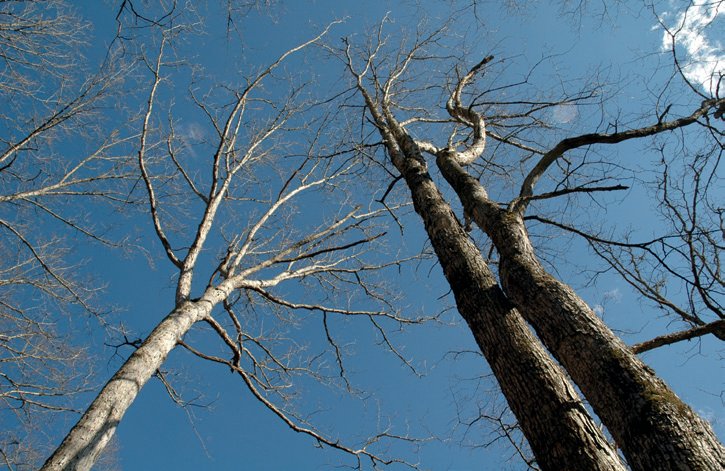
When released properly, my graduate students and I have recorded an average 20 – 25% increase in crown size among white oaks in previously closed-canopy stands the first year after release. Thus, the tree has the capacity to produce 20 – 25% more acorns in only one or two years without fertilization! Beyond that, following stand-wide retention cutting and prescribed fire, we have recorded, on average, forb and browse production increase from 50 to 800 pounds (dry weight) per acre. This has led to a 10-fold increase in nutritional carrying capacity (considering only plants eaten by deer and a minimum nutritional requirement) for deer during the growing season. Not to mention enhanced fawning, nesting, and brooding cover for wild turkeys. All without fertilizer!
Should trees ever be fertilized?
If, for whatever reason, you cannot help yourself and you must spend money fertilizing mature trees, then certainly you should only fertilize those trees that, 1) are inherently good acorn producers, and 2) have been released so their crowns can expand. If trees are grown in an orchard setting and have access to full sunlight, they may be fertilized to help maximize growth and development. But be aware, trees cannot utilize increased nutrients without adequate moisture. Probably more times than not, tree growth and production on upland sites is limited more by inadequate moisture than nutrients. When planting oaks on relatively poor sites, amending pH and fertilization may help ensure more rapid growth and development of the seedling, if adequate moisture and sunlight are available.
The final evaluation
There is no evidence that fertilizing oak trees in closed-canopy stands leads to increased acorn production. However, if fertilization did lead to more acorns, it would be necessary to identify the good producers and release their crowns to have any real effect. And then, any effect of fertilization would most likely be greatly reduced unless soil pH was above 5.5. Thus, liming would probably be necessary. And how much and what type fertilizer is needed? How often should fertilizer applications be made? Every year? Every other year? Regardless, given the natural variability of masting, fertilization would be a gamble because acorn production would still be susceptible to and limited by poor pollination, late frosts, drought, and acorn weevils. Any real effect of fertilization would be masked except during good mast years (at most, 2 years out of 5).
So, would the time and money spent be worth the return? With regard to nutritional carrying capacity, NO! There will always be more years of poor acorn production than years of good acorn production (even if fertilization did increase production), and this inconsistency, which is influenced by environmental factors beyond nutrition, would prevent any overall increase in nutritional carrying capacity. In terms of fertilization, time and money would be much better spent on food plots because of the consistent and reliable production from year to year. Likewise, time spent releasing selected trees and stand-wide retention cutting is certain to provide benefit, without fertilization.
Although sound reasoning does not suggest fertilizing oaks for increased acorn production is justifiable, recommendations for this practice still abound. To provide objective information on the issue, my graduate students and I plan to collect pre-treatment acorn production data for another year or two, then implement fertilization and release treatments to try and distinguish any effect of fertilization from release. Maybe we’ll have some definitive results in 5 – 10 years!