We get several calls a year regarding how to build a new lake or pond. Careful planning on the front end makes for an easier to manage and longer lasting waterbody later. There are many things to consider when building a lake, from location to the type of fish you want, and everything in between.
We recommend inviting a professional lake manager to meet with you on-site to look first hand at your property to determine the best location. Many times we have gotten involved after construction of a lake and many things completed could have been done differently that would have made the waterbody more productive for fish and wildlife, more aesthetically pleasing and more functional for alternative uses such as irrigation or storm water retention. It is advised to use both a local lake digging company and a fisheries consultant from the start to achieve the best possible outcome. Both have knowledge and expertise beneficial to achieve the best outcome feasible for your waterbody and objectives.
If possible, even before you purchase your property, have a professional fisheries consultant tour the property with you. I recently toured two properties with a new client who is considering buying one of them and he wanted me to provide technical advice on which property would be better suited for a lake and areas to attract waterfowl for hunting. We like to meet and even create a Management Strategy prior to the waterbody being dug so the landowner and construction company doing the work have guidelines to follow to assist in making the best possible waterbody to fit the needs of the landowner. A fisheries biologist and lake construction company compliment each other (may not always agree on every detail), but usually turn out a better product than if one is working alone without the other.
The first step is identifying a location. Don’t force a lake into an area that is not suitable for one. If your cabin is at the top of a hill, your waterbody probably cannot be located there due to no water coming in. The location you desire may dictate depth and size, which need to be considered to achieve your goals and the physical needs to create a productive fishery. What is the primary reason for the waterbody – fishing, waterfowl hunting, livestock watering, irrigation of crops, flood control or a combination? Will the waterbody be an embankment pond (where a dam is built across a stream, creek or drainage ditch) or excavated pond (a depression dug out and water sheet flows in from surrounding areas). I have seen lakes constructed at the highest point on the property that once went dry, never refilled. Check the acreage of drainage your location will receive. Enough volume of runoff must flow in to keep water levels acceptable, while the outflow must be large enough to safely discharge what excess flows in. Check up and downstream for potential flooding issues from either backed up water or a dam failure. What are the surrounding activities? A lake that receives 100% of its runoff from certain industrial, agricultural or residential activities may not be the best location and flooding or water chemistry problems may arise from those influences once the lake is complete and full. If a duck marsh is desired, place it downstream of the lake if possible, as marsh water is filtered but can be low in dissolved oxygen initially during a flood event. Identify the soil types to assure that once it fills, it will stay that way and if there is enough clay present to construct a dam, if needed. Some areas where lakes are built require clay to be brought in or an artificial liner be installed, both of which increase costs. Digging a few test holes prior to starting construction is advised to identify soil types and clay presence. We suggest, Ponds – Planning, Design, Construction, Agriculture Handbook 590 by the USDA as a reference for landowners to use when constructing a new lake or pond. It goes into great detail on much that I will touch on in this article. Obviously the internet is also another endless source of information, but identifying good information from hobby lake managers and builders can be difficult, so be careful.
Locating a qualified company to construct the lake is sometimes easy and other times hard. We recommend using a local company that is familiar with the area soils and permitting requirements while not requiring long distance travel, which increases costs. Start by talking with neighbors who have had lakes constructed. The County or State may have a list of permit requests in your area to help you identify who has recently built lakes. Were those landowners happy with their company? Have there been any problems with leaks, excessive weed growth and how is the fish population? Was the price reasonable? Another place to find quality construction companies is by interviewing local heavy equipment dealers and repair shops. They know a lot about their customers and who is reliable and not. Another source to locate pond builders is the local Agriculture Extension Office, the State Game and Fish Fisheries Staff or the nearest Natural Resource Conservation Service (NRCS) office.

Another thing to consider is funding. How will you pay for the new lake? In some instances the dirt is a valuable commodity either to be sold or used as a pad site for your home, cabin or lodge. We have several clients (especially in the South and low lying areas) that have had lakes dug for free in return for the dirt to be used in home or commercial property construction or City, County or Interstate Highway construction. This doesn’t always work out, but it is an option to explore prior to starting. Otherwise a location for the removed dirt to be deposited is required, and it cannot be used to alter wetlands into uplands or agricultural lands. There are also government programs; County, State and Federal cost share programs available for new lake construction. Contact your County Ag Extension and NRCS offices for any available types of programs in your area that may assist with funding. It will take you a few hours of time, but may be worth it in the long run.
Prior to construction, someone (you, your fisheries professional or your construction company) needs to check if any County, State or Federal permits are required for construction. Asking an Ag Extension or County Permitting Officer would be a good place to start. They know if any other agencies need to be contacted prior to construction. Each state and some counties within states are different in regards to new lake construction. Permit prices can range from free to several hundred dollars depending on location and lake size being constructed.
The final step prior to construction is determining the physical aspects of the waterbody such as size, shape, depth, bottom contour, shoreline slope, outflow and consider amenities such as dock, fish feeders, fish attractors and aeration system or fountain. We recommend building nothing smaller than one acre for a quality catfish and bream/panfish pond, not smaller than three acres for a pond with a few quality largemouth bass in it, and no less than 10 acres for a black crappie fishery.
Most desired species such as bream and bass are edge species, so the more irregular the shoreline the more edge and habitat available for those species. Those species spend most of their time hiding, feeding and reproducing in the Literal Zone (area between land and deep water where aquatic vegetation is located). There is a lot more shoreline where it zigzags in and out than a rectangular or circle shaped lake.
Depth is usually under or over done for various reasons such as cost, poor estimation of depth after completion or lack of knowledge on how important depth is during summer and winter (depending on where you are located). During a drought, some of the water needs to be eight feet deep, while no area (unless an aeration system is installed) needs to be greater than 15 feet. Water less than eight feet deep during the hottest part of the year can foster poor water quality with elevated temperatures and low Dissolved Oxygen (DO) either stressing or killing fish. This same scenario can happen with excessively cold water and low DO during winter in northern areas. Water over 15 feet deep in warmer climates becomes stratified, where low DO water is at the bottom and can be for more than half the water column, rendering no fish using these areas when DO is low to a point where it stresses fish or would kill them.
Bottom contour should not be smooth nor should there be isolated deep holes not connected by deepwater trenches. Adding “catfish holes” is acceptable as long as they do not exceed recommended depths and are not just deep holes randomly dug. The water in these areas without connecting trenches to mix with higher oxygenated water becomes unusable areas by fish due to lack of oxygen. If these areas have connecting trenches and/or bottom aeration, they become additional usable areas by all fish during different times of the year, increasing your lake’s carrying capacity.
Shoreline slope needs to be 4:1 or greater. The reason is that anything less encourages vegetation growth farther out into the lake and can cause problems in the future that requires constant herbicide use or scraping. Some shoreline vegetation is good, but too much too far out from shore can hinder angling and navigation, or create an aesthetic problem of undesirable weeds at or above the water surface. This slope discourages weed growth out from shore, but still promotes fish spawning by bass and bream/panfish. Many new lake owners feel the need to create large shallow shelves or whole lake ends for spawning, but these areas inevitably become problems in ponds with aquatic vegetation and are not necessary unless your waterbody is large and can afford such areas of space.
The type of outflow you have is usually decided on by the type of lake you have and costs. For an excavated pond, a low depression with gravel is sufficient. The use of gravel is advised to reduce erosion and any erosion at the outflow results in a lower lake level. For an embankment lake the ideal situation is a standpipe with a gate valve and emergency overflow. The standpipe allows water to flow out when it becomes full and normal rains are present. The emergency overflow is a slightly lowered area at one end of the dam covered in concrete or gravel for flood control that allows large amounts of water out during flooding without eroding the dam. The gate valve is a nice addition, but does increase costs for lowering water levels as needed. Reasons for lowering water levels include working on the dam, drying up organics (muck) along the edges, drying out weeds, and spraying excessive submerged vegetation reducing the acreage needing to be treated and lowering herbicide costs.


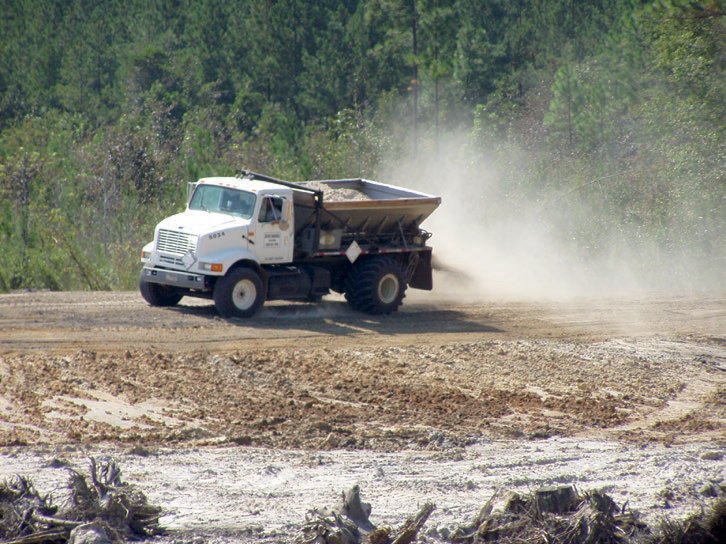
Most extras such as docks, fish attractors, fish feeders, adding lime and aeration systems or fountains can be installed either with the lake empty or full. A dock is easier to install while water is down. We recommend installing the posts only (leaving extra at the top) prior to filling and installing the decking and cutting off posts after the water has risen to full pool. This way you can place the dock as high or low as you want above the water at full pool. If you know the waterbody will fluctuate a lot, placing the top of the dock as close to the water line when full is advised, because most of the time it will be lower than full pool. If water will stay fairly steady despite rainfall amounts it can be placed higher knowing the water level will never be much lower than it currently is. If fish attractors will be made from natural materials such as brush, stumps, gravel (spawning beds) or concrete culverts, install them prior to filling so material can be driven to the spot and weighted down or spread with a tractor or dozer. If artificial materials are used, they can be easily thrown overboard and sunk from a boat once the lake is full and exact depths will be known. Shoreline or dock feeders can be temporarily closer to water if fish are stocked early, and permanently installed once water levels stabilize at full pool. They should be placed high enough not to get flooded should an excessive rainfall event occur. Installing a small gravel boat ramp is easiest before the lake is at full pool. Extend the gravel several feet down into the lake bed to assure a safe launch site even during low water. Check the soil pH around the lake site as you would for a food plot. Have your samples tested and whatever the pH is, that is what it will be in the lake. If the pH is below 6.5, add agricultural limestone as directed by the testing company to get your pH in the desirable range. It is much easier to add lime to an empty lake than a full one. Aeration and fountains can be installed prior to filling, but are easier to install once the lake has filled. This way there is no mistake of installing electrical outlets or pump motors at a level where they become vulnerable to water damage during a flood. They need to be placed approximately three-to-four feet above the emergency outflow to assure they are protected.
The final tasks are checking water chemistry, adding desirable plants and stocking fish. Have water chemistry checked prior to stocking to assure the fish will survive when they go in. On rare occasions we have seen elevated Ammonia or lower than normal pH upon filling that took a short time to stabilize and then fish were stocked. Plants need to be transplanted in specific times of the year. Trees in and around your lake should be planted in late winter, just prior to the start of the growing season. Trees to consider are cypress in the water and on edge and others near shore and up the hill for aesthetics, shade and to attract wildlife. Fruit and nut trees around a lake provide shade, food for wildlife and look good, especially when in bloom. Soft tissue plants should be planted in early spring just after the growing season begins so they have the full growing season to establish a good root system before the following winter and they become dormant and die back. Only choose native, non-invasive plant species to ensure low maintenance in the future. Fish can go in anytime, but the hatchery has to have them to do it. Usually bream/panfish are stocked in the fall or spring and bass 6-12 months later. Catfish can be stocked whenever the hatchery has them available but are cheaper when they bring other fish. For new lake stockings we also add either fathead minnows or mosquitofish for small bass and large bream/panfish forage to start, knowing eventually these species will probably disappear later from being consumed. Once bream, minnows or catfish go in, turn feeders on immediately dispensing small pellet size, high protein feed to expedite growth and encourage reproduction prior to predators (largemouth bass, Morone Hybrids or crappie) being stocked. Stocking a predator with no forage size present that is consumable is a waist of money and you are not gaining anything, just losing time. Also, bringing in fish from outside waterbodies usually doesn’t expedite anything, it just slows things down and may require additional stocking later to regain a balanced population. It does take a little time before you will see large bluegills, redear sunfish, largemouth bass, catfish, crappie or whatever your desired species are, but following proven guidelines and performing management tasks to upkeep the waterbody once complete will ensure a long successful time to enjoy your lake.