
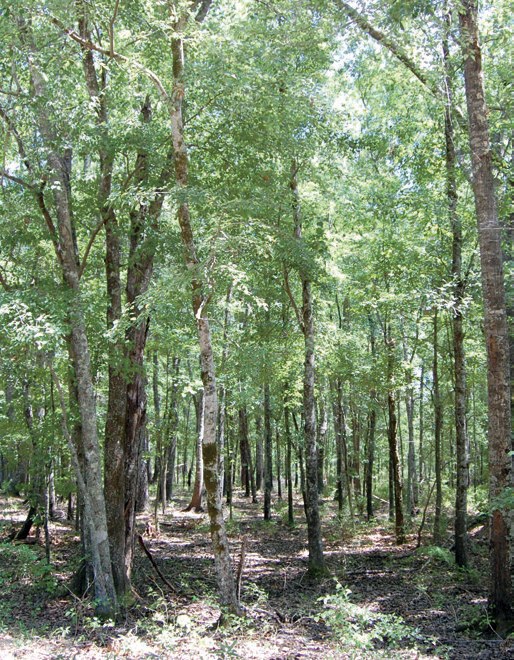
In the previous issue of this series, we discussed the role of pine stands and techniques to integrate timber and wildlife habitat management. Hardwood stands present unique opportunities as well as challenges to actively manage both timber and wildlife. Hardwood stands seem to be what every deer and turkey hunter wants to own and are often seen as a wildlife panacea providing acorns for all critters, from deer to quail, to eat and get fat on. Hardwoods are also seen as the prettiest woods to hunt in and enjoy. While there is a lot of truth to these statements, hardwoods present some unique management problems and they should not comprise the majority of your timber stands if wildlife management is a priority.
From a wildlife perspective, hardwood mast is highly selected by nearly all wildlife species. Hardwood mast includes both soft and hard mast types and includes oaks, (both red and white), persimmon, beech, hickory, elm, hackberry, sweetgum, poplar, blackgum, magnolia, and some mid-story species of “lesser” stature like mulberry, dogwood, catalpa, sourwood, holly, locust, redbud, cherry and sassafras among others. The most valuable timber species group as a whole is the oaks. From a wildlife standpoint also, the oaks are probably most important, however most other species have food and cover value, and at certain seasons are the “most important” food sources.
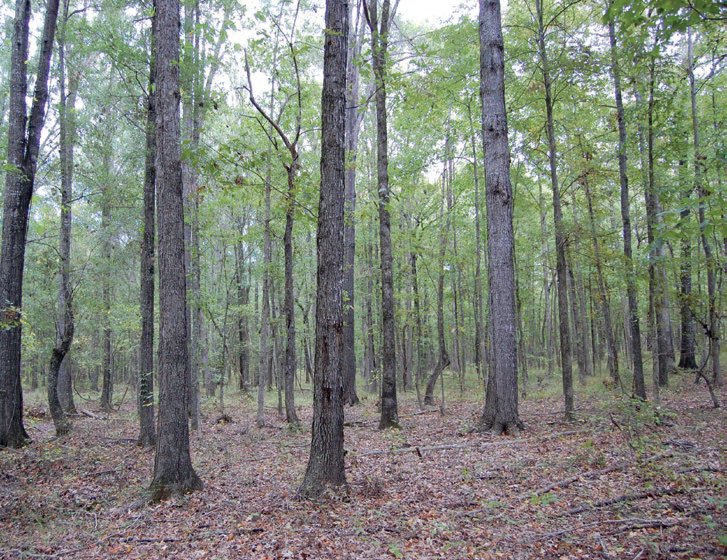
Managing for the most valuable species in hardwood stands is an important consideration because, in reality, hardwood stands are often strongly lacking in food sources. Most of the species mentioned produce food in the fall of the year and are dropping throughout the winter. By spring, most of the acorns, nuts, and fruits are eaten, rotten, or buried. Because of this, mature hardwood forests can provide poor wildlife habitat until they begin producing food again in the fall. While open understory hardwood stands are beautiful to hunt in and have a lot of wildlife in the fall and winter, the lack of understory vegetation within the stand throughout the summer often limits its wildlife value. This is why, for optimal wildlife habitat, hardwoods should not compose the majority of the timber stands on your property.
The problem is how to create conditions which promote understory vegetation within hardwood stands while not affecting the economic potential of the crop trees because of some of the characteristics that affect hardwoods such as shade tolerance and epicormic branching. If nice, mature hardwoods are thinned too much, the quality of the stand suffers from epicormic branching. Epicormic branching is the sprouting of dormant buds located along the main stem of hardwood trees that are exposed to sunlight. Even if the understory gets enough light to develop, it is transitional in nature and quickly grows into a midstory/shrub layer that will grow out of reach of deer and other wildlife. The second major consideration in managing hardwoods is the fact that certain trees are shade tolerant while others are not. Oaks are shade intolerant which means they require full sunlight in order to regenerate assuming there is an oak component present in the stand. Clearcutting is a vital tool in maintaining an oak component but clearcuts will also develop into shrubs and trees fairly quickly. Managing this understory can rarely be done with fire, as hot fires cause basal damage and mortality in hardwoods and it should only be done on a very intermediate time frame by the most experienced burners. Herbicides can be used to some extent, but care must be taken to use only those foliar chemicals that can be sprayed under hardwoods without killing them. The ideal situation for enhancing habitat is to limit the coverage of mature hardwoods (unless your property consists only of bottomland hardwoods) and manage pine stand understories, wildlife openings and fields.
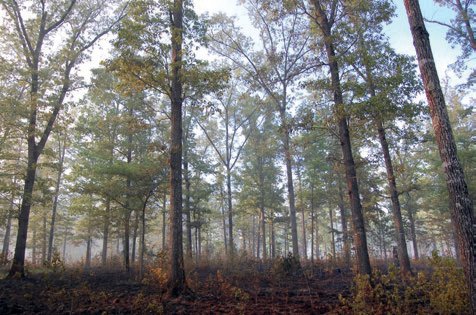
Many landowners are reluctant to “manage” (cutting and thinning) hardwood stands. The problem is that unmanaged stands eventually become old and exhibit signs of disease and slow growth. Even old oaks can die of old-age! It is also pretty common to see where someone attempted “select” cutting in a hardwood stand only to “high-grade” it by taking out the big mature sawtimber oaks without any consideration for oak regeneration. Do this 2 or 3 times and you may ruin the stand from both a timber and wildlife value perspective. Under this type of scenario the shade tolerant species (sweetgums, hickories, elm, etc.) will dominate the stand. This can also happen in older mature oak stands as older dominant trees die of natural causes and the shade tolerant species living in the understory invade the newly created openings in the canopy which are too small to allow good oak regeneration. This will eventually lead to a stand of shade tolerant species that will not revert to shade intolerant species (oaks) without a major disturbance of the overstory. So what alternatives are available for managing hardwood timber?
Getting Started
The first step to managing hardwood stands is to perform a timber cruise on the stand under consideration. This is important because it will establish a stand and stock table that will help you to decide what type of cutting if any may be reasonable. Harvesting timber, if done with a defined objective is your best tool for achieving your goals. Thinning, clearcutting or a combination of both all have their merits and are viable management tools if they are performed with a defined objective and set up correctly. If your timber cruise reveals the stand is healthy and has a good distribution of crop trees that are free to grow it may be prudent to do nothing. However, for this article we are going to assume some activity is necessary. If the cruise reveals a good number of desirable oak species with a good diameter distribution is in the stand but in a crowded condition then a selective cut is possible. If oaks are not numerous or are heavily weighted in the larger diameter classes (>24″ DBH) then a clearcut or regeneration cut should be considered. Many times a combination of both is the best course of action if practical due to some of the previously mentioned characteristics of hardwoods and the variations found in the field. A combination of the two will not only enhance wildlife habitat but it can be maintained on a regular rotation. A brief guide to all three harvesting techniques follows:
Clearcutting:
Clearcutting has a lot of bad connotations with most people but it is often an essential management tool and should be considered when there are few if any oaks present or if the stand is overmature. In most cases this alone will assure oak regeneration but in some instances there may be a need to plant desirable oaks to ensure their presence in the future stand. This is necessary in stands that have been severely high-graded for many years and don’t have much advanced oak regeneration or in situations where light seeded species are dominant in the local area and will impede the development of oaks. Clearcuts in hardwood stands (especially smaller patch clearcuts) have excellently wildlife value for deer browse, cover, turkey nesting habitat and adding diversity to a hardwood stand.
Selective Cutting:
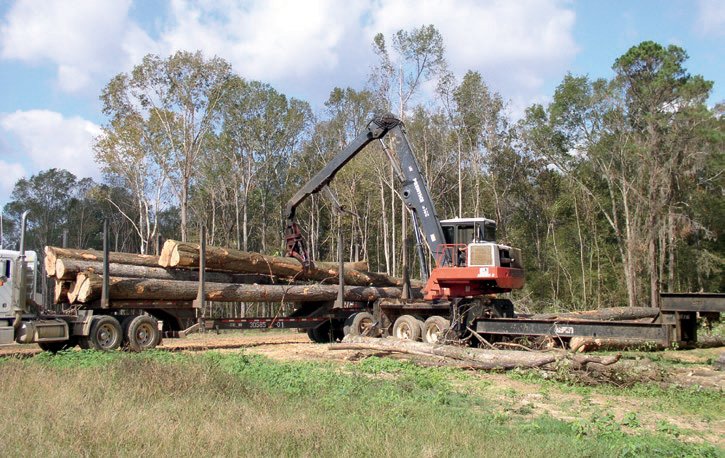
There are several objectives to try and achieve when thinning hardwood, however thinning is a viable alternative if it is done with a defined objective and set up correctly. The main objective is to leave a well stocked, evenly spaced stand of oak trees which are referred to as “Crop Trees”. Poorly formed and suppressed trees as well as unwanted and low-quality midstory trees should be targeted for removal. Secondly, undesirable species should be targeted instead of well formed oaks. Care should always be taken to not remove too much of the canopy as this will lead to epicormic branching. You can often leave undesirable species next to crop trees to provide shade on the bole. Another factor to consider is which side of the crop tree you are removing an undesirable tree, as trees immediately south of a crop tree provide shade to the north. The other target for removal is financially mature oak trees. This is a debatable figure but we feel oaks greater than 24″ at DBH are a good starting point. Both wildlife and timber managers should identify the best individual trees of the best quality species to mark and leave in a stand (crop trees) and remove trees growing in competition with them.
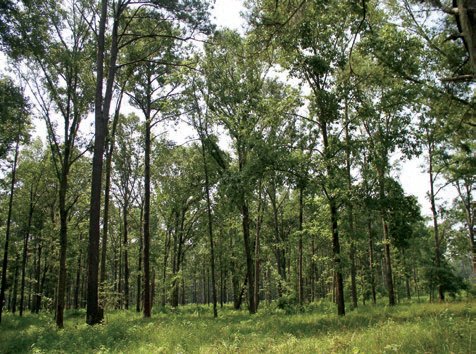
These thinned areas often respond with a flush of low growing understory vegetation that provides accessible summer foods and nesting habitat for wildlife. While shade eventually dominates the ground again, a few years of good understory vegetation is a bonus in thinned hardwood areas. Herbicides can also be used in these areas to kill undesirable species that often colonize a thin area. Species like privet, autumn olive, elm, ironwood, etc. can be killed to allow grasses and other annual weeds as well as oak regeneration to dominate the understory.
Combining Thinning and Clearcutting:
The process of incorporating both cutting strategies takes a lot of time and is more of an art than an exact procedure. However, using both is often necessary to properly manage hardwood timber. We incorporate clearcutting areas of varying sizes and shapes into selective cuts. The goal for picking the clearcut area is to pick areas within the stand that have poor species composition or areas with an over abundance of mature timber. It’s akin to group selection but we feel that the cuts need to be at least an acre and preferably several acres in order to get adequate sunlight on the ground for shade intolerant species and to avoid the potential problem of deer browsing and killing all oak regeneration. Total acres of clearcuts in an area also need to be geared towards making sure that there is enough browse available for the local deer population to avoid them killing all oak regeneration. These clearcuts provide an excellent food source for wildlife for a few years until they grow out of reach and also provide good cover, bedding and nesting areas. Thinning previously thinned stands can be scheduled on a 10 to 20 year rotation and if there is enough acreage you could break your stands into harvest units so that you could have more regular cuts to keep some habitat in a brushy nature. This style of management works extremely well in that it balances timber production, regeneration and wildlife habitat.
Reestablishment of Oak Where Not Previously Present:
As mentioned previously, it is sometimes necessary to supplement the planting of oak seedlings. We feel that planting 100 trees per acre and if possible have planters tie flagging on each seedling so that you can follow the planting with a back-pack application for herbaceous and unwanted hardwood control. In situations where light seeded species are going to be a problem it may be necessary to perform a chemical site preparation prior to planting just to give the planted oaks time to establish themselves. Once the seedlings are established just let nature take over and let whatever takes over grow. Attention should also be paid to tree selection for planting as topography, soil type and soil moisture should be used to determine the type of oak to plant. Just a few inches in elevation can be a deciding factor in which variety to plant.
Premerchantable Hardwood Management:
Young stands of pre-merchantable hardwood can be selectively thinned just like an older stand. The only difference is that it will cost money to perform this treatment. The main reason to do this is to speed up the growth on the crop trees and thus reduce the rotation length. It should be accomplished by picking the crop trees (best form and species) and cutting at least ¾ of the surrounding trees that are in contact with the crown of the crop tree to give the crop “free to grow” conditions.
In closing, the main thing to remember about hardwood timber is that it does need to be managed in a prudent manner if you have concerns about high value timber production and wildlife value. Because of the inherent growth, regenerative and species characteristics of hardwoods, just leaving them alone will not get you the results that you are looking for in the long term. In the short term you may never notice the difference but with no action you will be robbing the potential of your forests from future generations. Unmanaged stands exhibit poor growth, often have poor species composition, and often have limited or poor wildlife value. Additionally, many people in the past have high-graded their hardwood stands unknowingly by repeated light thinnings which they believed or were advised was good hardwood management. It is worth your money to seek experienced hardwood management advice if you are considering activities. One last thing to consider when planning for the future is that in our opinion we feel that quality hardwood timber will outperform pine economically over the long term. Looking at current prices, that in and of itself is worth actively managing your hardwood stands.