
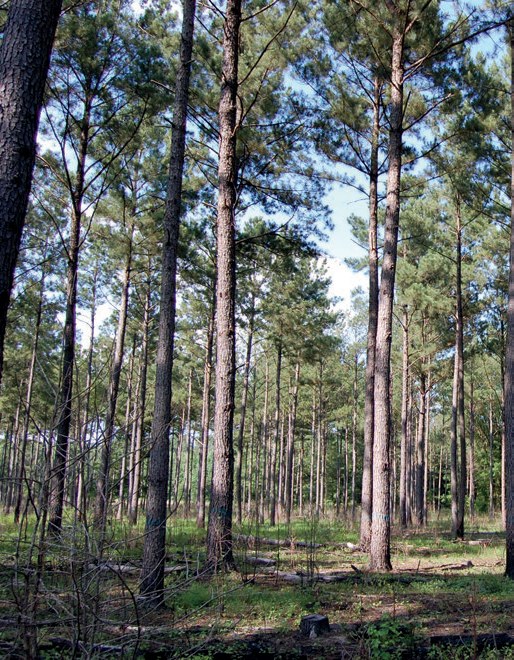
Pine stands. The backbone of southeastern forestry, but can it also be the backbone of wildlife management in the South? We believe so. More wildlife habitat can be created in pine stands and the associated reforestation techniques than any other habitat type. Well managed pine stands can be the epitome of true wildlife habitat management while providing good, periodic income for the landowner.
We have already covered the importance of breaking up, or diversifying, a property with stands of different species, ages and sizes in your management scheme, so let’s discuss management techniques utilized in pine stands and cover the different species a little.
Three major pine species are used in the Southeast for forestry and wildlife management purposes. Loblolly, Longleaf, and Slash pine are the most popular. All can provide good timber income, good growth and good wildlife habitat if managed properly. Historically, Longleaf pine occupied the drier upland ridges and slopes where well drained soils occur and natural fires burned regularly. In wetter flatwoods along the coast and Florida, both Longleaf and Slash pines occurred. Lower slopes and bottoms where fires were less intense or sporadic, Loblolly pine dominated. Changing forestry practices, burning regimes, genetic improvements, and reforestation techniques have made Loblolly the dominant pine planted north of the coastal plain and Slash pine dominant south of the coastal plain because both of these two pines exhibit speedy growth rates and fast returns. Longleaf has seen a resurgence of interest in recent years due to improvements in genetics and reforestation techniques, and therefore better survival and increased growth rates. With these improvements and changes in pine product markets, Longleaf has begun to appeal to landowners who are willing to forego short-term income (pulpwood rotations) for longer-term rotations like sawtimber and poles for which Longleaf is well known as a superior producer.

As far as Wildlife management goes, Longleaf is more often selected because it is more tolerant of earlier and more frequent burning, and grows with a more “open” crown allowing ample sunlight through the canopy and therefore allows understory plants to flourish underneath. Any pine stand grown with a “closed canopy” and pine straw groundcover is lacking wildlife habitat. If timber production is the only goal, closing the canopy with pine needles is perfectly appropriate as this allows all the productivity on the site (sunlight, moisture, and nutrients) to be captured by the pines and turned into merchantable wood. As the degree of wildlife priority increases, more and more of the site productivity needs to be allowed to grow understory weeds, grasses, forbs, and legumes by opening up the canopy of the overstory pine and hardwood. Similar to a garden, this is why full sunlight openings are so important in a wildlife management scheme. The difference however is that many highly nutritious and beneficial plants and weeds grow better in an open, burned pine stand than in an opening. There is also the tendency for landowners to disturb openings regularly with mowers and disks, changing the species composition. For instance, Dollar weed (a high protein woodland legume and excellent deer browse and quail food) occurs primarily in burned pine woods, but does not occur commonly in fields, nor does it like soil disturbance or mowing. Most native warm season grasses are similar, they respond well to sunlight and burning, however do poorly in shade or when disked.
That being said, how do we maintain this open nature in pine stands (even Longleaf which CAN close canopy and develop a pine straw dominated understory!)? We will cover initial planting density and site preparation techniques in the last installment of this series so looking at established pine stands, both pre-commercial and commercial thinning are the main techniques used to open up the canopy. High density naturally regenerated stands can often have 1,000 or more stems per acre and to keep trees growing and healthy, as well as provide understory plants, thinning to < 700 trees per acre (tpa) in pre-commercial stands, or < 250 tpa in commercial stands is necessary. The more wildlife benefit you want, the fewer trees per acre you can carry. As noted before, crowded trees are stressed trees which become susceptible to disease, insects and exhibit poor growth characteristics.
Pre-commercial thinning
In pre-commercial stands (those with average diameter less than 5″), thinning can be accomplished occasionally by prescribed burning. Two or three careful burns can often kill the smallest stems and leave the dominant trees growing well, but it can be hard to adjust the amount of kill and you can easily kill more than you wish. It is VERY feasible but usually recommended for experienced burners.
A more consistent technique is to use hand crews which either cut down undesirable stems with machetes or power saws, or inject the undesirable stems with herbicides. Leaving an evenly-distributed stand of 500 – 700 dominant trees per acre will allow good growth and a stand that can be thinned commercially once the trees reach an average of 7″ diameter.
Commercial thinning
Early thinning in commercial pine stands is important to maintain healthy growth rates, keep stands less susceptible to disease and insects, as well as promote understory plants. These thinnings also allow the landowner to remove diseased, poor growth form and suppressed trees from the stand. Thinning the stand back and leaving 100-250 of the best “crop trees” upgrades the value of the stand and concentrates growth on the best trees which will grow into higher valued products.
Obviously, if wildlife habitat is the priority, thinning to a lower tpa (trees per acre) range will be necessary. From a quail management standpoint, 100 trees per acre (in a 14-18 yr old stand) is still a well-stocked stand, and 200 tpa is way too many! While lower density pines will grow faster and healthier, there is an opportunity cost because carrying fewer trees per acre will leave fewer harvestable trees in future thinning operations. It may also adversely affect the quality of the residual timber by reducing the natural pruning that pine trees undergo in a more heavily stocked stand. In other words, thinning heavy and early leads to shorter and limbier trees in future years, allowing trees to grow thicker for longer results in a taller, less limby, straight tree. It is wise to consult your forester/biologist for assistance in marketing your timber, monitoring the logging job and making recommendations on residual density. Many variations on thinning are available from 3rd, 5th, and 7th row as well as corridor thinning in natural stands.
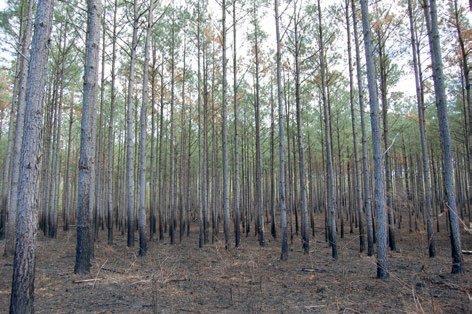
Future thinnings should be conducted as necessary to maintain the stand open enough to grow your target understory. Assuring that 50% or more of the ground under a pine stand has direct sunlight on it at mid-day is usually a target goal for quail management objectives. This usually equates to a 30 to 50 square feet of basal area. Re-entering the stand for thinnings every 4-10 years also lightly disturbs the understory changing the plant community somewhat and promoting different, disturbance-dependant plants for a few years. The larger and older your pines, the more value each individual tree has, so quality in logging and product merchandizing becomes extremely important. Timing of the sales to take advantage of markets as well as weather and soil conditions of the individual tract make a huge difference and the services of a professional forester can make a landowner money and give him peace of mind!
Mid-rotation management techniques
Herbicides
Wildlife Trends has had several articles dealing with utilizing herbicides in woodlands and openings. The brunt of using herbicides in pine woodlands is that young hardwood saplings compete for sunlight and nutrients in a pine stand just as the pines (which we want to grow well) and the understory weeds do (which we also want to grow well). In many scenarios, sapling hardwoods like sweetgums, oaks, ash or shrubs like saltbush and wax myrtle can completely take over the understory of a pine woodland after thinning, reducing its wildlife value to zero, just like if the pine stand was a fully closed canopy and the understory was pine straw. While there is some nominal value for cover for deer and turkey, these mid-story hardwoods shade out all of the valuable food and nesting plants wildlife require. Interestingly enough, burning in these pine stands rarely controls these hardwoods adequately and only keeps a portion of the stems from growing into trees.
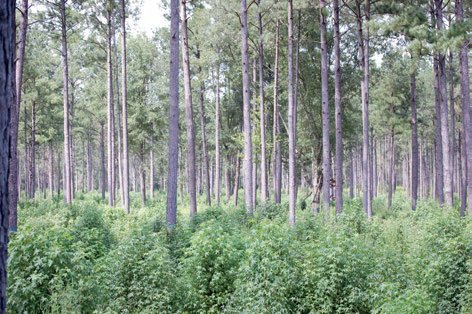
The simplest way to manage a wildlife property with diverse stands of both hardwood and pine is to keep them separate. Leave your hardwoods concentrated in the bottomland and pines on the uplands! While a hardwood bottom with some scattered big pine is wildlife friendly as is a burned pine stands with scattered white or post oaks, but most managed stands are more easily managed separately. Removing low-quality/value hardwoods from pine stands with selective herbicides allows understory weeds to flourish as long as the pine canopy is thin enough for good sunlight penetration. Once sprayed, the benefits last for years. Advances in herbicide technology have allowed for highly selective herbicides which kill selected groups of plants while promoting others. Selective herbicides such as imazapyr do a good job of killing hardwood stems and research has shown that wildlife friendly plants like beautyberry, blackberry, ragweed, partridge pea, as well as all native legumes are undamaged, however, it can damage things like longleaf pine and native grasses. Other herbicides like Triclopyr do an excellent job of killing hardwood sprouts while leaving native grasses healthy; however, they are tough on forbs and legumes. The point is that depending on what you have and what you want, there are often selective herbicides that will do a good job of establishing the plant community you are looking for.
Mowing/mulching
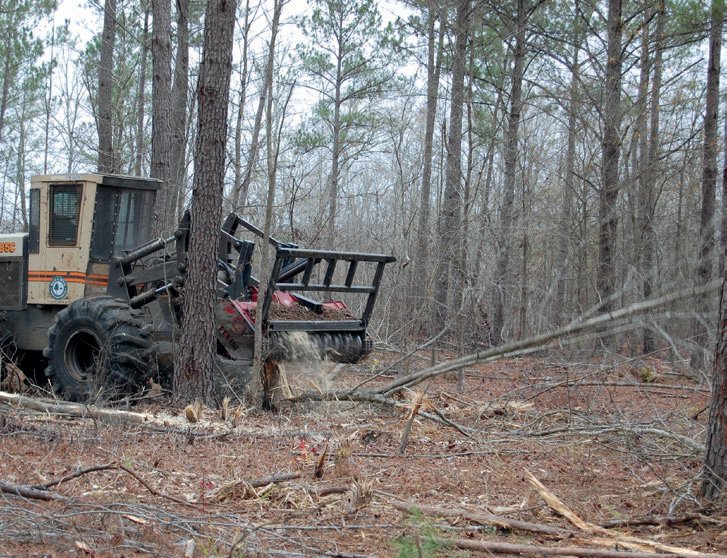
When sapling hardwoods develop in the understory and mid-story for too long without control, they become a heavy management problem. Stems that are too small for commercial harvest, but too large for conventional equipment like mowers need to be addressed with other means. Large, tree-cutter type mowers are available which can be tractor mounted and backed up into larger stems (up to 8″) and cut down. Any smaller stems that the tractor can run over can also be mowed down. This equipment is good for smaller acreages and is a slow operation. Woodland grinders have become more popular in recent years and can conduct this “cleanup” in short-order. They are available in larger equipment and have cutting heads up to 8′ wide and with 200 +/- Horsepower. These grinders can cut down larger (10′ +) stems and can grind them into mulch on-site. They can be used as an alternative to a bulldozer to clean-up woodlands and have the additional benefit of not disturbing the soil and leaving the woodland plants and grasses free to grow. Herbicides are often used as a follow-up treatment to permanently remove these hardwood stems.
Fertilization and Pruning
Forest fertilization has become more popular in recent years. Fertilization can provide for rapid growth of pines if soil conditions are lacking and can yield good returns on investment in the right soils. Once pines are thinned to desired density and the best “crop trees” are left, fertilization concentrates growth only on those trees deemed to become high-value. Fertilization with nitrogen and phosphorus is the most common application and the results of this technique also apply to the understory food plants wildlife management targets. The only negative consequence can be in very open pine stands with fertile soils that occasionally develop understories too thick for species like quail to move through and negotiate. Fertilization in this scenario may not be desirable.
Pruning has also become more popular for pine stand management. Pruning is especially helpful in pine stands grown at lower density at a young age. Low density plantings (250-400 tpa) typically do not limb themselves well and often grow thick lower branches which lower quality of marketable products. Pruning can help alleviate this problem by removing the lower limbs manually. Pruning prior to first thinning should concentrate on the best trees expected to be left once the stand is thinned and they can be pruned to @ 8′ by a hand crew with saws and machetes. After a few years and once pine stands have been thinned to desired density, the best “crop trees” can be selected to have additional lower limbs removed to @ 16′ leaving the first log clear of limbs and knots.
Prescribed burning
Prescribed fire is one of the most important and reasonably priced tools available for wildlife management in pine stands for the forest landowner. Conducted correctly, fire helps keep pine stands open, limbs up lower branches on pines, cleans up heavy accumulation of fuels and grasses on the ground, stimulates good wildlife plants like legumes, etc, and helps control small amounts of hardwood growth. Varying season of burning changes the amount of hardwood control and plant species composition. For the best wildlife productivity, all burnable pine stands should be regularly burned, but broken up so that plenty of upland, unburned cover remains after the fire. Even very young loblolly stands (6 years or so) can be successfully burned, helping remove excess pine and hardwood, limbing young pines and opening the stand to allow better wildlife movement through the stand. Although Longleaf can and should be burned at young ages (2 years), care must be taken when burning Longleaf which is 2′ – 5′ in height as this is the one stage where they can be damaged by fire. Using an experienced, professional prescribed burner is always a good idea in all but the simplest woodland fires.
The opportunities to increase wildlife value in pine stands are great. By manipulating stand density and understory composition, well-managed pine stands can create some of the best available wildlife habitat in the Southeast. Each of the above topics could have an individual article written on it, and all can significantly increase wildlife habitat and timber value. While the amount of openings on a property and what is planted in them can have a significant impact on wildlife, many if not most properties in the Southeast have a significant portion of pine. These areas can easily compose the backbone of the wildlife habitat on the property if properly managed. The measure of true Wildlife Management is not necessarily in what, how much, or where you plant things. It can more readily be measured in how well your pine woodlands are managed.
In the next issue, we will examine opportunities for integrating timber and wildlife considerations in Hardwood stands.