
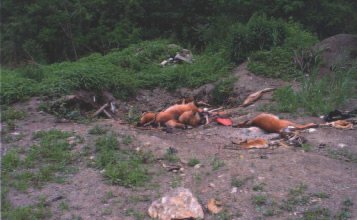
Hunters across the Southeast harvest approximately 3.5 million deer each year. This is a lot of deer carcasses to deal with! It is our responsibility as hunters to properly dispose of the remains of these deer in an environmentally, health conscious, and aesthetical way. The composting of deer remains has proven to be an acceptable method for hunters to dispose of deer carcasses. Not only is it a safe and environmentally sound method of disposing deer remains, but will result in a nutrient rich material (actually called compost) that can be added to food plots, supplemental fruit tree plantings, other areas on your property, or your garden. The objectives of this article are to introduce you to an alternative way of disposing deer remains, help you better understand the composting process, its benefits, and how to successfully compost deer remains.
Traditional Methods of Disposing Deer Carcasses
How do you dispose of deer remains after dressing your harvest? Those who can afford the luxury of taking their deer to a commercial deer processor do not worry about how to get rid of deer carcasses. They leave this up to the processor. However, those who can not afford this option, or do not have it available, are faced with figuring out what to do with the remains of harvested deer. Many landowners and hunting clubs have a designated “gut pile” on their property where they dispose of their remains (parts left after the butchering process such as entrails, hide, rib cages and other bones). All of us have seen (or smelled) a gut pile. It is not a pleasant place to be even for a short time to toss another deer carcass out. Not only do these areas smell bad, but they impose environmental and safety hazards to people and wildlife. Another option employed by some hunters is creating “deer pits” whereby they dig a hole with a tractor, dump deer remains into the hole throughout the season, then cover the hole after deer season. While this is certainly a better method than a simple gut pile, it has similar problems associated with it. Unfortunately, some hunters toss deer remains into a ditch or even worse into a creek, river, or lake. Many of these hunters believe this is the best way to dispose of deer carcasses and in some cases even think they are providing food for fish, turtles and alligators. Nothing could be further from the truth. How many of you have seen a rank deer hide or carcass floating in a creek? Although some of the meat may be eaten, the vast majority of it just slowly rots which results in pollution to the water it lays in posing serious environmental and safety threats. Dumping deer remains into a body of water is by far the worst method to use. Oxygen is a key ingredient needed for decomposition. While there is oxygen in water, it is rapidly depleted around something “rotting”. This results in anaerobic conditions (without oxygen) where undesirable bacteria thrive. Anaerobic bacteria are the most harmful bacteria that cause disease. Why do you often see catfish farmers or recreational lake owners running aerators (the big paddle wheels churning the water)? Although it is a complicated process that involves many factors such as water temperatures, wind activity, etc., the primary reason is because they have experienced an algae bloom, the algae has died, and the activity of aerobic bacteria has depleted the oxygen and increased water temperatures which are harmful to the fish.
Additionally, they are trying to prevent conditions that are favorable for the harmful anaerobic bacteria to thrive. Bottom-line, don’t throw your deer remains in water – it’s bad!
What is composting?
In its simplest definition, composting is the decomposition of organic matter. More specifically, it is the process in which solid organic materials are decomposed in the presence of oxygen through the action of bacteria and other microorganisms. All organic matter will decompose at some point. However, rather than allowing nature to take its slow course, composting (the management of a compost pile) provides an optimal environment in which decomposers (bacteria and microorganisms) can thrive which significantly increases the rate of decomposition. To encourage the most active microbes, a compost pile needs the correct mix of the following ingredients:
- Carbon (wood chips, sawdust, leaves, straw)
- Nitrogen (food scraps, grass clippings, manures, and in our case deer carcasses)
- Oxygen (provided by mixing or turning the compost pile)
- Water (either added or by rain – but moisture content is managed)
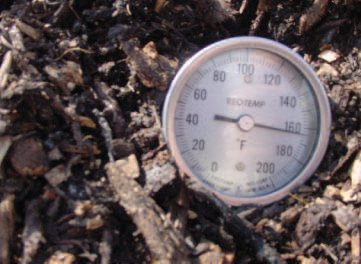
An effective compost pile is kept about as damp as a well wrung-out sponge. This provides the moisture that all life needs to survive. Bacteria and other microorganisms fall into a variety of groups in terms of the ideal temperature range they thrive in and how much heat they generate as they do their work. As these decomposers break down and process organic matter (eat it) they generate heat. This causes the temperature in a composting pile to rise, and the inner part of a compost pile heats up the most due to the insulation provided by the outer layers. Have you ever opened a bag of mulch and noticed how warm it felt? The bag had probably gotten wet at some point and decomposition had begun. Due to the heat generated from the intense microbial activity, temperatures of a properly designed compost pile can reach 90-140 degrees Fahrenheit within four to five days. These temperatures are desirable because they kill most pathogens and weed seeds while providing a suitable environment for thermophilic (heat-loving) bacteria, which are the fastest decomposers. Thus, if you have done a good job creating a compost pile, the inner part of your pile should be warm to the touch. Because these bacteria release enough energy to heat a compost pile and keep the biochemical reactions going, composting can begin in the cold of winter. Obviously, this is good news for hunters wishing to compost deer remains since deer are harvested in the fall and winter.
Composting Dynamics of the Windrow Method

Windrow dynamics is basically the natural or unassisted airflow and subsequent bacterial activity of an undisturbed windrow caused by the rising of heated air. The following cross sectional diagram illustrates the concept of windrow dynamics.
Zone # 1 represents what is referred to as the Dead Zone, or the anaerobic spot that normally begins immediately in a newly formed windrow.
Zone # 2, which is the most active zone, is the hottest and has the most biological activity. This Zone is the ideal zone and can be the “Sweet Spot” of composting. It is possible, however, to have temperatures rise too high in this zone and begin to destroy beneficial bacteria. Zone # 3 is the least compact zone in the entire row. It is cooler than Zone #2 but warmer than Zone #1. Bacterial activity in this Zone slows down rapidly as the moisture evaporates and cool air penetrates it. However, Zone #3 is important because it serves as an insulating layer for the compost pile.
Managing a compost pile
If you are a good deer manager, chances are you will be a successful compost pile manager. The goal of a composting system is to provide a healthy environment and adequate nutrition for the rapid decomposers (bacteria and other microorganisms). Does this sound familiar? To best manage our deer herds, we make all attempts to ensure they are living in a healthy environment (desirable population size, balance sex ratio, etc) and provide them with adequate nutrition (quality habitat, food plots, supplemental feed, etc). Managing microorganisms is not quite as fun, but has its similarities. Properly managing the moisture content and ensuring there is adequate oxygen in the composting pile are the keys to providing a healthy environment for the decomposers. Providing the needed nitrogen and carbon materials is the key in providing adequate nutrition for these decomposers. Managing these four primary ingredients (water, oxygen, nitrogen, and carbon) will increase the rate of decomposition.
Water
Water is very important for the composting process. But too much water will drown the microorganisms, and too little will dehydrate them. A general rule of thumb is to keep the material in your compost pile as moist as a well-wrung sponge. If your pile is too dry, you will need to add water. Adding water to a deer composting pile is easiest done while turning the pile. Simply sprinkle or spray water as you turn it. You want to try to maintain consistent moisture content throughout the pile. Adding water to the top of the pile will work, but is not preferred because water does not reach the center of the pile. However, sometimes rain is the only source of water for deer composting given that they are often located in remote areas. A deer composting pile that is too wet will often have a “rotten” smell and fluids draining from the bottom. If your pile is too wet, simply incorporate more wood chips or sawdust. This is similar to adding more flour to your pancake batter if it gets too thin. Another option to dry the pile some is to spread the pile out. This will allow evaporation to take place. Once the pile is dry enough, rebuild the composting pile. If you expect heavy rains, place a tarp over your pile. A tarp can help retain moisture as well.
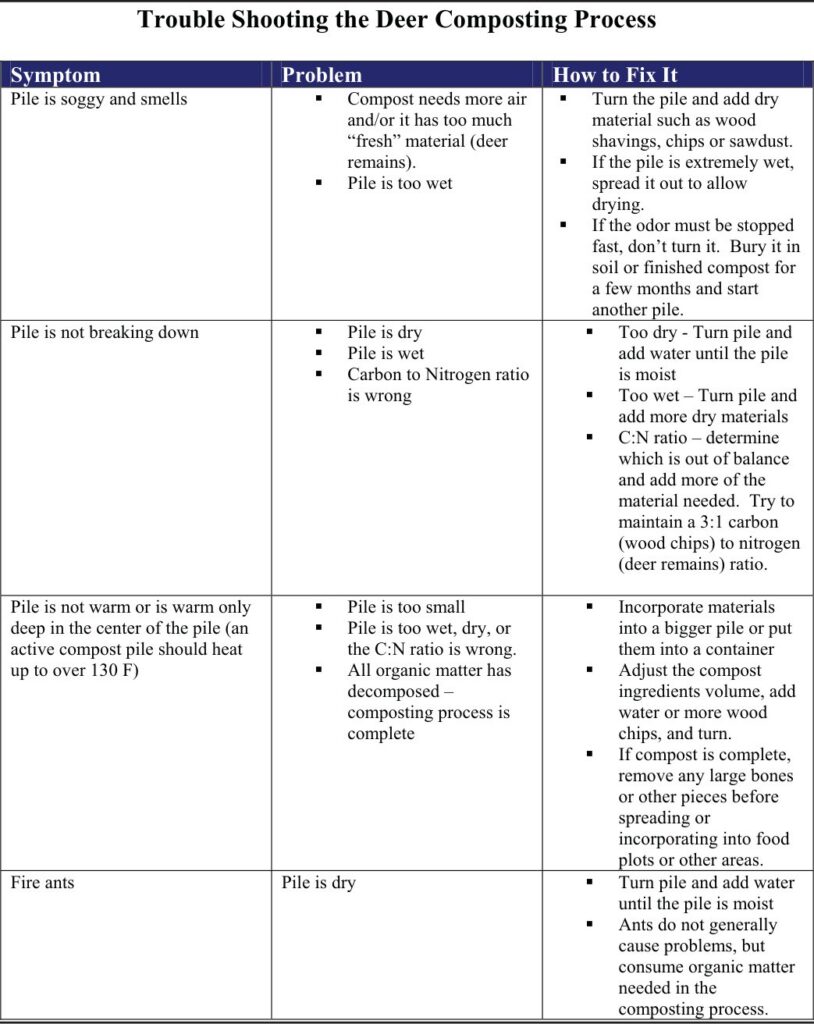
Trouble Shooting the Deer Composting Process
Oxygen
To do their work most efficient, microorganisms require a lot of oxygen. When your pile is first assembled, there will probably be plenty of air between the layers of materials. But as the microorganisms begin to work, they will start consuming oxygen. Unless you turn your pile or aerate it, they will run out of oxygen and become sluggish. Obviously this will cause the decomposition rate to slow down. Unless speed is a priority, frequent turning is not necessary. Some hunters never turn their pile because they are not concerned about rapid decomposition. The purpose of turning is to increase oxygen flow for the microorganisms, and to blend undecomposed materials into the center of the pile. For the most efficient deer composting, turning and restacking the pile every couple months is adequate. After turning, the pile should heat up again as long as there is still undecomposed material to be broken down. When the temperature stays pretty constant no matter how much you turn the pile, your compost is probably ready. Though turning the pile can speed the composting process, it also releases heat into the air, so you should turn your pile less frequently in cold weather.
Carbon
Carbon-rich materials are the energy food microorganisms. You can identify high-carbon plant materials because they are dry, tough or fibrous, and tan or brown in color. Examples are dry leaves, straw, sawdust, wood chips, and cornstalks. As with most things in life, diversity is best. If you have access to various sources of carbon, add/mix them into your deer composting pile.
Nitrogen
High-nitrogen materials provide the protein-rich components that microorganisms require to grow and multiply. Examples of high-nitrogen materials include fresh grass clippings, over-ripe fruits and vegetables, and other moist green matter. Other high protein organic matter includes animal manure and by-products like blood and bone. Obviously, deer remains will be the source of nitrogen for hunters disposing of deer remains.
What is the best deer composting recipe?
Microorganisms and other soil fauna work most efficiently when the ratio of carbon-rich to nitrogen-rich materials in your compost pile is approximately 25:1. In practical terms, if you want to have an active compost pile, you should include lots of high-carbon “brown” materials (such as wood chips, sawdust, or dry leaves) and a lesser amount of high-nitrogen materials (deer remains).
If there is an excess of carbon-rich materials and not enough nitrogen-rich materials, a compost pile may take years to decompose because there is not enough protein for the microorganisms. If your pile has too much nitrogen and not enough carbon, the pile will also decompose very slowly and will probably be soggy and smelly along the way.
For hunters composting deer, don’t worry about determining the exact carbon content of a material or achieving a precise 25:1 ratio. All organic matter breaks down eventually, no matter what you do. If you simply use about 3 times as much “brown” material (wood chips, sawdust, etc) as “green” material (deer remains) you’ll be off to a great start. With experience, you’ll get a sense for what works best.
Directions – How to operate and maintain an active deer composting pile
There are essentially two ways to compost deer remains; using a compost bin structure or creating piles (called windrow composting). The compost bin is more expensive because it must be built, but it offers a more controlled environment for composting. One of the primary benefits of a compost bin verses an exposed pile is the ability to manage the moisture content. Exposed piles are susceptible to heavy rains that can cause them to become too wet. For detailed directions on how to build a compost bin, refer to Joan Love Smith’s article in the October 2003 issue of Wildlife Trends, or contact Wildlife Trends. Because most hunters are more likely to use the windrow or pile compost method, the following directions are for creating and managing a composting pile. However, directions for either are basically the same.
Select a suitable site for creating a compost pile. Ideally, the site should be located on a relatively flat area to avoid run off. For hunters, logging decks are usually great places to compost deer remains. Additionally, a fresh logging deck will probably have an abundance of wood chips and sawdust that can be used in the composting process. Do not select sites that are near a watershed or a site that may run-off to a watershed.
Prepare a foundation layer of high-carbon materials such as wood chips, sawdust or recycled compost. This initial layer should be about 3 feet wide by 5 feet long and a foot or two deep.
Place deer remains or deer carcasses on the foundation leaving about 6 inches or more between the carcasses. Note – Do NOT add antlers because they do not break down as rapidly and could puncture tractor tires while turning the compost pile or spreading the complete compost on food plots. Completely cover the deer remains with at least 6 inches of high-carbon material. Don’t worry about being exact. Just remember that you want to keep the carbon to nitrogen ratio around 3:1. Also, don’t be concerned about creating “layers”. Mixing is preferred. Just make sure all deer remains are adequately covered to prevent varmint problems as well as keep the initial smell down.
Continue adding deer remains to the pile as they become available.
Do not stack a pile higher than 5 feet high. Once the pile reaches about 4 feet, add about 12 inches of carbon material to cap the pile.
Even during the winter, a properly constructed compost pile should heat quickly and reach desired temperatures of 90-140 degrees Fahrenheit within 4-5 days.
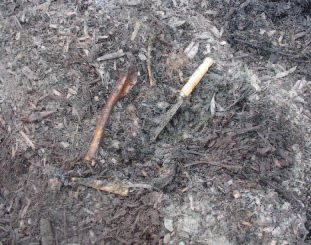
Monitor the moisture and oxygen content as the compost pile “bakes”. Turn or mix the pile if more oxygen is needed. Add water if the pile is dry. Add wood chips or other carbon based materials if the pile is too wet. A compost pile temperature of 125 degree Fahrenheit or higher indicates that the composting process is working. Refer to the “Managing a Compost Pile” section for management activities needed if the process is not working.
If you want to speed the decomposition rate, turn or mix the pile every two months or as needed to maintain a “hot” compost pile.
Under ideal conditions and active management, deer remains can be completely composted or decomposed in as little as 3-5 months. However, under good conditions and moderate management, 6-8 months is a more realistic time frame for the decomposition to be complete.
Not only is composting a safe and environmentally sound method of disposing deer remains, but will result in a nutrient rich material that can be added to food plots, supplemental fruit tree plantings, other areas on your property. Additionally, a properly managed compost pile is virtually odorless which makes it a great alternative to common gut piles created by many hunting clubs. If you have never composted deer remains, you will be quite surprised at how easy it is to do, how quickly the deer remains break down, and how many uses you will find for the final product – very fertile compost. Good luck with your new hobby!