
The very words “red-cockaded woodpecker” have the ability to stir instant emotion in people. For many, you might as well have slapped them in the side of the head as made them hear those awful words. For others, life-long work and worry is focused around the biology, well-being, and recovery of this species. Liaison by nature, I can see the underlying rationale that drives both of these viewpoints. Today in the southeastern United States however, more and more landowners are mending their relationship with the red-cockaded woodpecker (RCW) and changing their veiws regarding this species and the “big pine timber” ecosystems they inhabit. The truth is that the RCW is simply a species that became dependant on a particular type of habitat, much like the bobwhite quail. A habitat system that was once very common, stretching almost continuously from southern Virginia to east Texas. That system was, of course, the mature longleaf pine woodlands that occupied more than 90 million acres of the coastal plains, uplands, and even mountains across the South. When the longleaf ecosystem was common, the RCW was common. My grandfather saw some of the last big virgin longleaf stands in Alabama during his years in the log woods with a crosscut saw. He said “heck boy, in those days there was one on every ridge”, referring to the groups of cavity trees or “clusters”, described later. While RCWs also lived (and still do) in mature slash, shortleaf, and loblolly stands, longleaf was (and still is) by far the most important tree to the RCW.
Now, with less than three percent of that original longleaf habitat remaining (due to agricultural clearing, logging, free-range grazing, fire suppression, and other factors), the rarity of the ecosystem and its associated habitats has led to drastic declines of several plant and animal species, including the RCW. These declines led to federal protection and laws, with the passage of the Endangered Species Act in 1973, aimed at keeping species from becoming extinct. While the vast majority of the remaining mature longleaf occurs on federal or state lands, some private and industry landowners were affected by the laws. And when people were informed that they may be found liable for “take” if they planned to clear-cut their big longleaf sawtimber and had RCWs, they understandably developed a sense of dislike for the bird. But these mindsets, as well as the management implications set by the federal government, have changed a bit in the past three to four decades, for government agencies, industries, and private landowners. As we have learned more about the RCW, the longleaf ecosystem, timber management, and people, it appears that there’s some common ground after all. In fact, many of the timber sale projects (i.e. timber volume) that presently occur on USDA Forest Service lands in the southeast are driven by RCW habitat management. That’s right, the RCW generates timber projects. If that’s not enough, now some private landowners (timber managers), and even timber companies, will proudly tell you they own habitat occupied by RCWs or that they are working hard to try to get them. So what’s the deal? Why the change of heart? We will discuss those changes but first let’s learn a bit about our subject.
RCW Biology and Life History
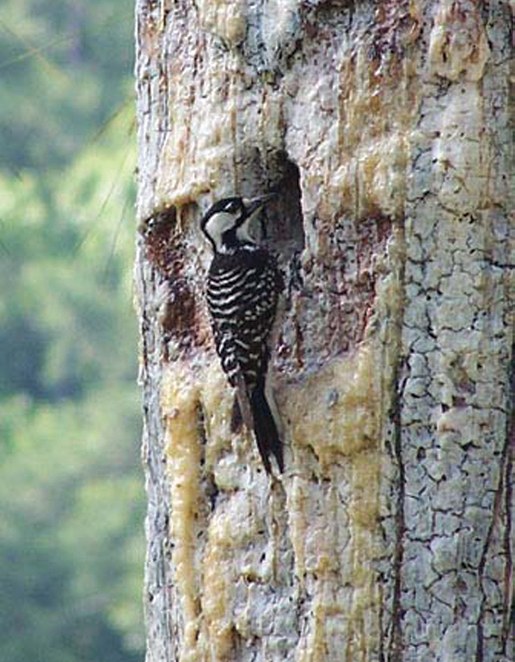
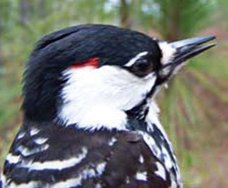
The federally endangered red cockaded woodpecker (Picoides borealis) is a relatively small bird, about the size of a cardinal, with black and white markings. It looks similar to our downy (P. pubescens) or hairy (P. villosus) woodpeckers, but can be distinguished by its barred back, a large white cheek patch, and its short nasal call. Adult male RCWs have a tiny “spot” of red feathers at the top of each cheek patch, known as a “cockade”, while females do not. However the sexes are generally indistinguishable from one another in the field. Juvenile males have a larger, more noticeable red spot on the top of the crown. RCWs are atypical birds in that they are cooperative breeders. This means breeding pair of adults often gets support from one or more male helpers, usually offspring from the previous season(s). Young females and the males that don’t stick around to be helpers typically leave the cluster by their second spring. Usually they don’t go far, although some have been documented to have traveled long distances. Nesting and roosting, for the most part, takes place in cavities that the birds excavate in old live pines, usually longleaf. Cavity excavation takes a long time to complete, often several years. A RCW cavity entrance appears perfectly round, about two inches in diameter. Elongated pits in live pines are usually foraging holes made by the much larger, and more common, pileated woodpecker (Dryocopus pileatus). Once the RCW cavity is completed, the owner will generally return to the same cavity each night to roost. The RCW causes the living pine to exude sap or resin around the cavity by keeping several small wounds, called resin wells, open and flowing. This sticky resin flow has been shown to be an effective barrier against climbing snakes. The family groups are highly cohesive and typically live together in a group of cavity trees referred to as a “cluster”.
Nesting season generally occurs around April and a typical clutch size is two to four. These eggs are most likely laid in the breeding male’s roost cavity, and will hatch in only about eleven days. Young are fed by all members of the family group. The RCW’s diet consists mainly of insects, spiders and other arthropods found on the trunks and in tops of trees; these trees generally are larger pines. Food availability is dependent on habitat quality, therefore habitat management is likely a good way to improve their abundance.
RCW Habitat
RCW’s require mature live pines for roosting and nesting habitat (the cluster site), preferably >80 years, with little or no hardwood midstory encroachment in the area. Quality foraging habitat would contain a similar component of pine timber, although younger stand age and a limited amount of midstory is usually tolerable. The “open” park-like conditions of the stands are generally maintained, of course, with the use of frequent prescribed fire. This open spacing of large pines coupled with frequent burning builds a diverse herbaceous understory of grasses, legumes, and forbs that is also an important component in quality RCW habitat; as a result, insect abundance remains high. “Good Quality Foraging Habitat” is technically defined in a few pages of the US Fish and Wildlife Service’s RCW Recovery Plan (2003 revision), but in a nutshell, good RCW habitat essentially looks like good bobwhite quail habitat with an open stocking of large pines. However, unlike bobwhite requirements, the pine timber component is mandatory for the RCW. In fact, many of the same management tools that create good quail habitat are used for RCW habitat management. And yes, that management includes timber thinning over time. As stands get too dense, say >80 ft2/acre in basal area, the herbaceous understory becomes sparse, lower-level canopy structure becomes less open, and they begin to look less appealing to RCW’s. Timber thinning to benefit RCWs is sometimes conducted with group or “patch” cuts, where small patches of timber are harvested through the stand, or more commonly with “bottom up” thins, where mainly intermediate pines and hardwoods are harvested, leaving the oldest longleaf. The ability to keep an active timber program, while managing for longer rotations of poles and sawtimber, is one reason folks are taking an interest in RCW’s.
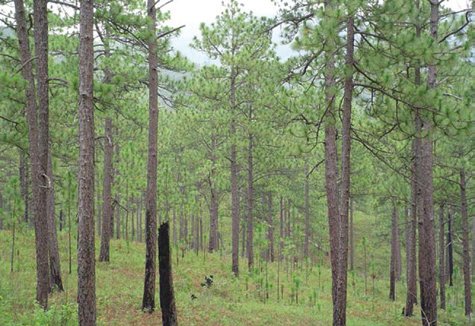
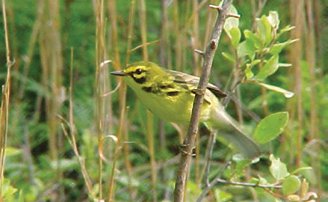
Notably, proper habitat management of (old-growth) longleaf forests for RCWs and bobwhites benefits numerous other flora and fauna. Several declining wildlife and plant species are tightly associated with the same open, fire-maintained conditions. Species like Bachman’s sparrow (Aimophila aestivalis), prairie warbler (Dendroica discolor), and brown-headed nuthatch (Sitta pusilla) and several reptiles including the glass lizard, (Ophisaurus sp.) and gopher tortoise (Gopherus polyphemus) are often common in RCW habitat. However the most notable diversity is observed in the plant communities of the understory. A typical understory in RCW country would consist of several native grass species, dependent on soils and location, including wiregrasses (Aristida spp.), bluestems (Andropogon spp, Schizachirum spp.), and Indiangrass (Sorghastrum spp.). Native legumes including partridge pea (Cassia fasciculata), creeping lespedeza (Lespedeza repens), and beggarweeds (Desmodium spp.), to name a few, would also be common. There would be an almost countless variety of forbs including asters (Aster spp.), bonesets, (Eupatorium spp.), and goldenrods (Solidago spp.). Again, all of this might sound familiar to you from a quail management standpoint. This abundant, diverse understory generates the abundance of food (the food that will find its way up into the trees) rendering high quality RCW foraging habitat. And, as you have learned from previous articles in Wildlife Trends, early succession under pine stands is also a great habitat for white-tailed deer and wild turkeys. The associated wildlife benefit (for both game and non-game species), along with the release of rare plant communities, resulting from RCW management is another reason for the increased interest in RCW management by private individuals.
Modern RCW Management
According to the revised RCW Recovery Plan (available online at the website link provided), in 2003 there was an estimated 14,068 RCW’s living in 5,627 clusters across eleven states. Most of these birds live on National Forest lands, with the Apalachicola National Forest population being the largest (at approximately 665 active clusters). National Forests are considered to have the most important role in the recovery of the RCW because that is where the vast majority of the longleaf is. Military installations are considered to be second in line followed by National Wildlife Refuges and other federal and state-managed lands. The remaining 23 percent of RCW groups are found on private lands, although old longleaf timber is generally rare on private property. There is increasing interest from individuals and timber companies to manage their properties to a higher standard than is required, to aid in the recovery efforts.
For the most part, RCW managers practice similar management techniques across the South. These commonly are prescribed burning, hardwood midstory control, timber management, artificial cavity installation, population monitoring/banding, and translocation of birds. There are specific guidelines spelled out in the Recovery Plan for each of these tools. Controlled burning is the key to successful maintenance of a longleaf stand for red-cockaded woodpecker habitat. Growing season burning is somtimes used by RCW managers to effectively control the woody species encroachment in the stands. Frequency of burning varies but is typically conducted every 1 to 3 years on most intensively managed tracts. Longleaf are exceptionally adapted to surviving fire. However, they can still be killed by fire. Caution must be taken when planning and conducting prescribed burns, as retention of an adequate number of old longleaf is essential in RCW management. A common practice used to protect the cavity tree resources from fire weakening or killing them is to rake the litter back away from the base of the cavity trees in the cluster prior to the burn. Ignition methods can also be adjusted to help ensure the cavities and older trees in the stands don’t get too hot during the burn. Research has shown that unwanted mortality in old longleaf stands is sometimes caused by burning when the duff layer was too dry or there was an extended period of no rain after the burn, leaving the duff to smolder and cook the fine roots and/or cambium at the base of old longleaf trees. A long period of fire suppression adds to the risk of mortality while prescribed burning as well.

In pine stands that contain significant hardwood or undesirable midstory encroachment, it is usually necessary to physically reduce this structure to create or restore suitable RCW habitat. These “midstory” treatments can be achieved via timber sales, chainsaw contracts, or using herbicides. RCWs can tolerate limited structure in the stand’s midstory but will abandon the cluster if it becomes too dense. The same goes for the overstory; it can’t become too dense or the habitat quality declines. An ideal canopy closure for RCW management is one that allows enough sunlight reaching the ground to produce a total coverage of herbaceous plants, while also having enough tree substrate to most efficiently forage on. This usually equates to longleaf basal areas ranging from around 40 to 70 ft2/acre.
An adequate amount of this open, good quality foraging habitat should be available within ½ to ¾ mile of the cluster site. How much is an “adequate amount” of quality forage habitat? The Fish and Wildlife Service recommends that federal agencies, state lands, and private individuals who desire to increase their RCW population, should maintain at least 120 acres of quality habitat per breeding group of birds. However, if the landowner is merely concerned with maintaining enough foraging habitat to prevent the requirement of obtaining a permit for “incidental take” they are typically bound to a significantly smaller size, usually around 75 acres. Individual situations are often analyzed by the Fish and Wildlife Service on a case by case basis so that a workable plan can be developed.
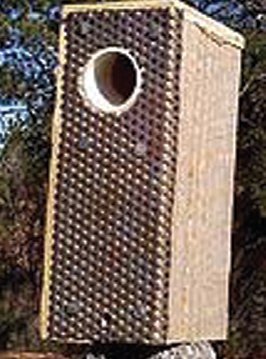
Availability of old longleaf trees (greater than 80 years) used for nesting is typically a limiting factor on the lands that support RCWs. The older trees are used by the birds for building cavities because they often are infected with red-heart fungus that softens the heart of the pine, making the task of excavation much easier. To supplement this resource, managers commonly install artificial nest boxes (inserts) in younger live pines, essentially buying time until more trees in the stand can reach the age required for excavation. Inserts must be used in trees that are large enough (typically greater than 15 inches in diameter at the point of installation) to safely accommodate the box. Typical preparation for the installation is done with a small chainsaw and the insert is glued flush into the tree with wood putty. If installed correctly, they are often difficult to distinguish from natural cavities at a distance. RCW’s in the immediate vicinity usually take to these inserts fairly well. Drilled cavities sometimes are also used in recovery efforts.
Most RCW managers also conduct some amount of monitoring and banding. These techniques require permitting from the appropriate agencies. Information gathered from the efforts is recorded and used when it comes time to capture and move “extra” birds from one location to the other (translocation). Essentially it gives you the knowledge to tell “who’s who”, so that breeding adults are not accidentally taken from a productive cluster. Extra birds used in translocation are generally young females and helper males that come from large (over 100 active clusters) populations. These areas often have more population growth than habitat growth so they donate birds to smaller populations with suitable habitat. Moves within a population are sometimes conducted also.
Safe Harbor Agreement
As you may have figured out by now, these guys are specialists that are finicky about where they live. They are actually quite intolerant of poor habitat and on more than one occasion I have watched them abandon what appeared to me as great RCW habitat. However, if you hold property that is somewhat near an existing population, and you do have open pine sawtimber, there is a possibility that red-cockaded woodpeckers might use your habitat. The Fish and Wildlife Service realized that people’s fear of “getting” RCWs was causing a lot of old longleaf habitat to be clear-cut. This trend was not only detrimental to RCWs, but to other associated plants and animals relying on longleaf ecosystems. A great remedy to this dilemma was the Safe Harbor Program that came into effect in 1999.
Under the Safe Harbor Agreement, a landowner who manages their pine forests in a manner beneficial to the RCW is provided certain guarantees. Prior to enrollment, the government will conduct a survey to determine the baseline number of clusters on the property. If woodpeckers happen to increase on an enrolled property, owners are only held liable for the baseline number. The landowner retains all property rights but agrees to provide a net conservation benefit through the use of some of the management practices that we have previously discussed, including increased timber rotation and prescribed burning. The government will also help enrolled parties to obtain financial assistance in the form of grants and cost-share programs to help cover the costs of these activities. Upon termination of enrollment, any birds that have occupied the property during enrollment can be relocated. For more about the red-cockaded woodpecker Safe Harbor Program in Alabama visit the FWS Safe Harbor website at http://www.fws.gov/daphne/rcw/rcw-safeharbor.html.
Summary
The majority of RCW management occurs on public lands. However, private landowners, bird enthusiasts, and general conservationists are now concerned with their management, not only for the single-species of RCW, but for the entire longleaf ecosystem, whereby numerous species (flora and fauna) benefit from the successful management of this habitat type. In some respects, RCWs are indicator species where their “picky-ness” indicates when the habitat is poor. And, despite hostility and/or enmity that exists toward RCWs, the management for these guys is oftentimes synonymous with bobwhite quail management and a whole host of others. Further, recent programs have been developed to aid landowners financially and physically to manage these ecosystems properly to restore sustainable longleaf habitats yielding healthy forestlands as a whole, and also to protect private landowners or, minimally, free them of concern from increasing RCW abundance on their properties via the Safe Harbor Program.
After years of effort, research, and communicating with folks, modern RCW management in today’s South seems to be working, both for the birds and for the people involved. If you are interested in learning more about the management of red cockaded woodpeckers, to find out if you are near existing RCW populations, or if you need assistance with the verification of their presence on your property, contact your nearest US Fish and Wildlife Service Field Office or link from the Safe Harbor website above. Please understand the information provided in this article is based on personal observation and the regulating agency (USFWS) should be consulted before any action is taken regarding RCWs.