
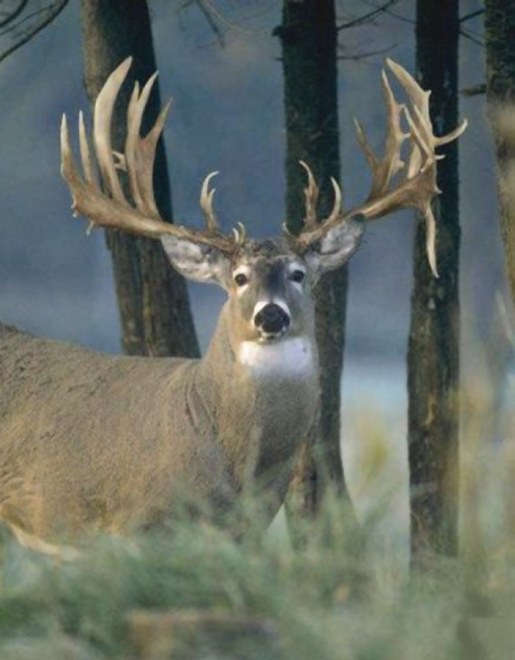
As a wildlife consultant, one of the most common questions I am asked by small landowners is “Is my property big enough to manage deer on?” and this is usually followed up with “am I wasting my time?” This is a tough question to answer without knowing more about the specifics of the property in question such as the size/shape of the property, wildlife habitat quality (food and cover resources), management on adjacent properties, resources/ability to apply management strategies, and of course what the person means by “manage”; that is, what their true deer management goal is.
First let’s define what I consider a small property as it relates to managing deer. Deer home range sizes (the area a deer uses and lives in) vary throughout the country depending on the time of year, habitat type, habitat diversity, habitat quality, food resources, and other factors. As a general rule, home range sizes of deer are generally larger in poorer quality soils/habitats such as those associated with the lower coastal plain regions compared to that of deer in more fertile soil regions. Research has shown that the average home range of adult bucks varies from several hundred to a few thousand acres. Home ranges of adult does are slightly smaller. However, many studies have shown the average home range size of a whitetail deer is roughly a square mile or 640 acres. Research also indicates that most young bucks disperse one to several miles from their birth area between the ages of six and 24 months. Therefore, to have control over and manage a “deer herd”, without depending on adjacent property management, you need at least several thousand acres. Even then you are still sharing deer with your neighbors. In fact, even if you own, manage, or hunt 10,000+ acres you will be sharing deer with your neighbors, but on a property of this size you will likely have control over the deer that use the core portion of the property. Having said this, I consider properties less than 1,000 acres to be small from a deer management perspective primarily due to the relatively large home range sizes of white-tailed deer and the dependency on neighboring landowner/hunter management. If your property is 1,000 acres or less, don’t worry. There is still hope. Successfully managing deer on small properties simply requires a little more effort which often includes working closely with your neighbors to ensure they are on the same deer management strategies along with strategic habitat management strategies that will help you attract, hold, and grow exceptional deer. In fact, I work with many landowners and hunters that have successful deer management programs on less than 500 acres (some even smaller acreage).
There are essentially three key ingredients common to all successful small property deer management programs I’ve work with: 1) they strategically and aggressively manage the habitat on their property to meet daily life needs of a deer – not giving deer a reason to want to leave; 2) they have good relationships and form deer management cooperatives with surrounding landowners or hunting clubs where possible; and 3) they keep disturbance to a minimum and hunt smart.

Strategically and Aggressively Managing Your Deer Habitat – Where Do You Start?
The first step in improving the deer value of your property is to determine/establish your specific deer management goals. If your general goal is to manage for better deer, do you want to produce quality or trophy bucks? Specific goals usually dictate the level of management needed. The intensity of management and timeline of reaching your goals will also depend upon how much you need to do and on the resources (time and money) you can devote. Whichever may be the case, once you have established your goals, an assessment of the property is in order. As part of the assessment, and with your specific goals in mind, you need to determine the strengths and weaknesses of your property as they relate to deer.
Although most hunters can conduct a general property assessment, you may need the assistance of an experienced professional wildlife biologist to determine the less obvious and often times overlooked strengths and weaknesses. The goal of the assessment is to identify the limiting factors of your property that will prevent you from reaching the deer management goals. Strengths and weaknesses (or limiting factors) are generally related to food and/or cover. On small properties, it helps to know the strengths and weaknesses of your neighbor’s property. Although this doesn’t sound very “neighborly”, you need to know what your “competition” has to offer deer so that you can do a better job to attract and hold more deer. For example, if your neighbor’s property is predominately mature bottomland hardwood or open agriculture with little cover for deer, you need to ensure your property has exceptional cover that will attract deer to your property.
With your deer management goals in mind and from this assessment, you and/or your wildlife consultant may develop a list of several to many management activities that will address limiting factors identified. Depending on the property, this can be a relatively short list or a very long list of activities that need to be addressed. Obviously, if your property is “raw” with few wildlife enhancements, you need to address the basics – food and cover. In fact, even the advanced fine tuning habitat management strategies are geared towards improving food or cover. Examples of habitat management activities often implemented to enhance small properties may include timber harvest, installing or enhancing food plots, thinning/fertilizing/applying herbicide in pine stands, managing hardwood habitats for increased mast production, creating more habitat diversity, increasing or decreasing the amount of open land or mature forest, initiating controlled burning, managing roadsides and field edges, creating more escape and bedding cover/habitat….the list goes on. As a landowner or land manager, the list of activities can be overwhelming.
Now that you have your “to-do list”, where do you start? Many of these management activities may require significant resources (time and money), may be seasonal, or long-term oriented. The answer is simple. You prioritize the management activities and tackle them as you can. Prioritizing means that you are addressing the most important or value-adding activities first.
Below is a list of common habitat management activities/strategies that are commonly used to enhance the deer value of small properties:
Plant and manage quality year-round food plots
Developing quality food plots is certainly a good first step to adding wildlife value to your property. As a rule of thumb, I recommend devoting a minimum of 1% and ideally 10% of your property to food plots. On small properties, food plots will serve as an attractant for deer and should be managed for year-round production of quality forages. Year-round quality food plots consist of annual (summer and fall) and perennial plantings. Including annual and perennial clovers are a safe bet in most soils and will attract and benefit deer. If your goals include turkey and/or quail management, include areas of small grains and seed producing crops such as millets and sorghums. The residual stubble of these crops, particularly the taller crops such as Egyptian wheat, often provides excellent fawning cover.
Manage Roadsides – Roadside management refers to actively managing roadsides to enhance habitat for wildlife. Examples of such management include mowing, disking, planting, etc. Managing roadsides is an exceptional way to add deer value to a small property. Even on relatively small properties, there are usually several miles of roads and many opportunities to significantly enhance wildlife habitat by simply managing the small areas on the shoulders of these roads. Managing these areas add up and can result in many acres of additional quality wildlife habitat and hunting opportunities on your property.
Daylight and fertilize native habitat around food plot edges or along roads
Deer are browsers meaning that they spend most of their foraging time eating leaves, stems, or buds of plants and trees. A common misconception is that deer are grazers – meaning they primarily eat grasses like a cow. When deciding where to improve natural browse areas along food plot or road edges, concentrate on areas that already have existing quality vegetation such as honey suckle patches, briars, and other desirable weedy species. Even if there is only a small amount of desirable browse species, daylighting and fertilizing normally results in an explosion of these plants. Daylighting simply refers to removing undesirable trees and brush that are competing with the quality, desirable plants for sunlight and nutrients. A chainsaw and/or selective herbicide applications are the tools of choice for this task. Fertilizing will increase forage production and nutrition levels of these areas as well as create excellent cover habitat.
Timber stand improvements (TSI)
Removing undesirable tree species in and around quality oaks to reduce competition and promote better tree growth and mast production. There are many methods for implementing TSI. Some of the most common include selecting individual trees to be removed and cutting them down (and spraying herbicide on the stumps to prevent future stump sprouting), killing the trees with herbicide (hack & squirt methods) and allowing them to fall on their own, and if the area and timber is large enough, commercially logging the undesirable trees (which means revenue!).
Clear the understory and fertilize quality oaks
Cutting down and clearing undesirable trees and shrubs under and around a mature oak will reduce competition for sunlight and nutrients which will enhance the growth and productivity of the oak. This is commonly referred to as “releasing” an oak. Fertilizing these trees will further enhance tree growth as well as mast production. Time released fertilizers are recommended as they will provide nutrients over the entire growing season. This is a great way to create a bow hunting honey hole for deer or great place for squirrel hunting. Since fertilizer is relatively expensive, I recommend selecting a few of the best oaks in key locations to concentrate fertilizing efforts. One high quality mature oak can produce a tremendous amount of acorns.
Install wildlife friendly oak and fruit orchards
Adding various fruit trees and shrubs in and around a food plot or along roadsides will provide additional food resources that will enhance their attractiveness. There are many fruit tree species that will benefit deer. Some of these include: sawtooth oaks, dwarf chiquipin oaks, chestnuts, persimmons, plums, apples, pears, and many other species. When deciding what to plant, try to incorporate multiple tree species that will fruit at various times of the year. This will ensure food resources are available throughout longer periods of time of the year.
Install and maintain supplemental feeders
For deer, supplemental feeding not only provides attraction, but will also provide additional nutrients and minerals for deer that will enhance body growth, reproductive success, and antler quality. There are many types of feeders available. I recommend trough type feeders because they allow the use of quality pelleted feeds that would fall apart if broadcast on the ground due to moisture and rain. If you are using feeders to attract deer for hunting, I recommend trough feeders with programmable feed drop systems. This allows you to condition deer to be there when you want them to be. Although it depends on the quality of your soils and habitat, one feeder per 100 acres is normally adequate. Just remember that supplemental feeding is not a substitute for proper habitat or herd management….it is a supplement.
Install and maintain mineral licks
In addition to providing supplemental feed in feeders, installing mineral licks may provide additional nutrients and minerals for deer if needed. Mineral licks should be created in early spring and monitored and refreshed as needed throughout the summer. One mineral lick per 150 acres is adequate for deer. There are many “pre-made” mineral licks on the market or you can simply create your own. A recipe I like is 50# Dicalcium phosphate, 50# Granular Calcium Carbonate, and 50# trace mineral salt – plus a small amount of an attractant like “Deer Cocaine” or “Black Magic” (just something to get them interested in the site).
If needed, create a small water hole – Although most wildlife do not need free standing water to supply their body with daily water requirements, most find them attractive and will use water holes throughout the year, particularly during warm weather or droughts. Water holes do not need to be large. I’ve created many that were the size of a pickup truck. The key is to create them in a spot that will collect runoff from surrounding areas and will always hold water – particularly during drought conditions.
Use fire to create and maintain quality wildlife habitat
Prescribed fire is an excellent tool for creating habitat diversity and quality deer habitat on small properties. Burn areas do not have to be large to be beneficial. Areas of 1-3 acres are sufficient to be value adding and are easily burned in a couple of hours. To enhance habitat diversity, divide the area around a food plot into several units and schedule fire rotations for a different unit each year. That is, do not burn the same unit each year. Although it will depend on soil fertility, a 2-3 year burn rotation creates the best habitat for deer. Also, take advantage of the fire breaks. These are great places to plant food plots for deer or field border crops such as Egyptian wheat, sorghums, millets, and other small grains that will benefit turkeys and quail.
Install wildlife clearcuts
If quality cover and/or natural food is a limiting factor on your property, consider installing small 5-10 acre clearcuts. Properties where cover or natural food is a limiting factor are typically mature forests such as bottomland hardwoods, upland hardwoods, or old growth pine stands. Not only will this generate revenue, but it will add habitat diversity and provide quality food and cover for about 4-5 years. Consider creating hunting opportunities such as funnels, travel corridors, and bottlenecks while designing the shapes and layouts of the cuts. When considering where and what shape to make these small clearcuts, think about the area as if it were a lake that needed structure. Place the “structure” (meaning the clearcuts) in a way that will not only provide deer with the most food and cover, but in a way that will help you hunt deer as well.
The strategies listed above were just a few of the value adding management practices that can be used to create or enhance a small property for deer. Of course every property is unique, and the strategies you use will be dictated by limiting factors that exist on your property as well as your management goals. Again, the goals of a habitat management program on a small property is to meet the daily life needs of a deer, but more importantly make your property very attractive for deer (which is normally the result of meeting their daily life needs).
Deer Management Cooperatives
In most cases, successful deer management on small properties requires working with adjacent landowners or hunters to ensure similar herd management strategies are being applied. When several properties are working together towards common goals it is often referred to as a “deer management cooperative”. Obviously the goal is to get as many landowners and hunters to participate as possible so that you have “control of the deer herd” over a larger area. Given the relatively large home range sizes of white-tailed deer, the more land under management the better, and any increase in acreage likely will improve management success.

The first step to establishing a deer management cooperative is to identify potential members. Properties immediately adjacent to your property are the most important, so concentrate initial efforts there. Sometimes, identifying the landowners and hunters on adjoining properties may be difficult. One of the best ways is to talk with key landowners who have lived in the area for many years. They often know who owns properties in the area. Other good sources include the ownership platt maps, county tax office, county agricultural extension agent, or your local private lands state wildlife agency biologist. Once all the landowners and hunting groups have been identified, contact each personally and invite them to a meeting to discuss the possibility of forming a deer management cooperative. Providing a BBQ dinner is always a good start.
Membership in a cooperative can be formal or informal. If you are only working with a couple of landowners or adjacent hunting clubs, a formal written agreement is not usually needed. However, if many properties and people are involved, I recommend developing a more formalized membership approach that includes a simple written agreement signed by each landowner and club representative indicating they will abide by the established guidelines, though they may enact more stringent requirements on their own property. Guidelines of the agreement should be simple, easy to understand, and include the goal(s) of the cooperative and minimum buck and doe harvest requirements. It is also a good idea to establish some formal acknowledgement of cooperative members such as property signs, vehicle decals, and membership cards. All will help identify members and assist with identifying trespassers and poachers.
A deer management cooperative benefits a deer herd in many ways. The most obvious benefit is that they enable landowners and hunters with small landholdings to harvest better quality bucks. Goals of deer management cooperatives are generally geared towards increasing buck quality, maintaining a relatively balanced adult sex ratio, and maintaining a desirable deer density; all of which promotes increased deer herd quality and improved hunter satisfaction. Other non-biological benefits of a cooperative may include sharing resources such as tractors, planting efforts, or other equipment and enhanced recreational value of all properties involved. Many cooperatives save money by ordering bulk fertilizer, seed, and supplemental feed. Additionally, I’ve known of several great friendships that have developed through involvement in deer management cooperatives.
Once a cooperative is established, the challenge will be to keep it intact and moving in a positive direction. This is not always easy and will require work. The key is to keep it enjoyable and to keep members informed and involved. Annual meetings should be held to share annual harvest data, trail camera pictures and to assess the progress of the cooperative. Many cooperatives use a wildlife biologist to collect and analyze their harvest data and to provide harvest recommendations for the next season. Depending on the needs and size of the cooperative, a period newsletter is also a good way to keep members informed. Involving property or club representatives in the decision-making process for the cooperative will build ownership in and commitment to the program. Another great way to keep everyone involved and participating is to implement competitions, incentives, and awards for following rules and achieving goals. Possible examples include quality buck and doe contests, prizes for oldest deer, and most improved property. Other awards might include the property with the fewest number of button bucks or undersized bucks harvested or awards for individuals that have made significant contributions to the cooperative.
Almost without exception, a non-member group within or adjacent to the boundaries of the cooperative will create problems for existing members. These properties may range from those not hunted to those allowing the harvest of deer of any sex or age. Both situations can present real problems. Unhunted properties can be both a blessing and a curse. They are great places for bucks to seek refuge during the hunting season, which enables more to survive, but large, unhunted properties can make it difficult to harvest enough antlerless deer to maintain proper herd density and sex ratios on your property. Uncooperative neighbors that do not follow the deer harvest guidelines also can limit management success. Several years of success may be required to convince these hunters of the merits of the cooperative. Regardless, never give up hope and keep these landowners and non-member groups informed of the activities and successes of the cooperative. If all else fails, recognize that some losses to neighboring properties will occur and manage accordingly.
Quiet Please – Managing Hunting Pressure
Managing the disturbance and hunting pressure is particularly important on small properties to promote quality deer hunting experiences. Too much disturbance or pressure can curtail deer sightings (particularly mature bucks), or worse, could ruin the deer hunting on your property in short order. After devoting much time and many resources to properly managing the habitat and deer herd on your property, the last thing you want to do is run the deer off or force them to be strictly nocturnal (which is the most common effect).

Reducing the hunting pressure does not mean you have to hunt less. It simply means you need to hunt smart. Regardless of how large a property is, I feel that hunting smart to manage the hunting pressure is the key to consistently having successful and fun hunts. Hunting smart means you place stands in a way that allows hunters to access and exit them without disturbing the deer and you never hunt them unless the wind direction is favorable. With some planning and a little effort, this is easily accomplished. For example, do not place shooting houses or other stands directly on food plots. Rather, place them far enough in the woods that hunters still have a good view of the food plot, but are concealed from deer using the plot. If this is not possible, consider planting a portion of the food plot with a tall crop such as corn or Egyptian wheat to “screen” hunters getting in and out of the stand. Also think about the direction hunters will access the stand and avoid situations where the hunter has to walk across a food plot to get out. Stands in the woods should be set up in a similar fashion considering where the deer will likely be such as a bedding area. As you learn where deer are and their movement patterns on your particular property, these decisions will get easier. Don’t laugh, but on my hunting club, we actually rake trails through the woods to clear leaves and other debris to allow hunters to get to and from stands quietly. Surprisingly, it doesn’t take a lot of effort or time to create the trails with a yard leaf rake or gas powered blower. You may be amazed at how effective and quiet you can slip through the woods along a bare dirt trail. Due to the quietness I suppose, deer often start using these trails as well!
If there was only one recommendation I could provide regarding reducing hunting pressure, it would be to ALWAYS hunt with the wind in your favor. The wind is your friend if you use it correctly, or it is your worse enemy if you disregard it. I’ve been fortunate to have worked and hunted with several hunters that take great bucks every year. These are the guys you see in the hunting magazines standing in front of a barn wall full of big bucks. There is a common strategy that all of them employ…they are obsessed with the wind and which direction it is blowing. Many of these hunters have hung stands they couldn’t wait to hunt, but never sat in them all season because they never got the right wind. A deer’s sense of smell is without question its strongest defense. I recommend making a list of stands on your property and determining which winds they can be hunted and post this at your camp. In fact, my hunting club has a rule, and a fine associated with breaking the rule, that states stands can only be hunted under favorable wind conditions. Here’s a good self check to see if you hunt with the wind: If you know which stand you are going to hunt the day before arriving at your property, you are not hunting with the wind. In fact, if you know which stand you are hunting in the morning before you go to sleep, you are not hunting with the wind.
Hunting with the wind is relatively easy on flat terrain, but can be quite tricky on properties with a lot of relief or rolling topography or near large bodies of water due to the eddies in wind flow, diversions, and drafts. If your property is hilly or on a large lake or river, take the time to learn how the wind reacts on different parts of your property. Hunting smart to reduce hunting pressure requires hunters to be students of the wind.
Reducing disturbance during hunting season is another way to reduce pressure on deer. Again, this is particularly true for small properties. Avoid gas powered ATV’s such as 4-wheelers, mules, and rangers for joyriding or when accessing stands. There’s not a deer in the Southeast that doesn’t associate the sound of a 4-wheeler with something negative. Electric powered ATV’s such as golf carts or simply using a truck is less intrusive and will allow you to be stealthier. Keep other disturbances such as target shooting, joyriding, or other activities to a minimum as well.
In some cases, reducing hunting pressure will mean hunting less. Even if hunters are “hunting smart”, too much hunting will have negative effects on deer movement. I see this quite often on properties that have several different hunters using the property such as a hunting club or on small properties that are hunted by a single hunter that is obsessed and hunts every chance he gets (and who doesn’t?!). I collect and analyze hunter observation data on many properties I manage. This information hunters record each time they hunt such as date, stand, deer observed, etc. It amazes some hunting clubs to see the results. Hunting clubs often feel they do not apply heavy hunting pressure, but when all hunter observation data is combined and analyzed, results often show that someone in the club hunted nearly every day of the season! Individually, hunters may not be applying a great deal of pressure, however, collectively they are applying significant pressure that will effect deer sightings. A solution to this problem on larger properties is to break the property into hunting units and rotate hunting pressure throughout the season. That is, hunt area A & B during week one while area C rests. Then hunt area B&C during week two while area A rests, and so forth. This is an effective way to reduce hunting pressure and “rest” areas to promote better hunting. On small properties, however, rotating hunting areas is not an option and the solution is simply to reduce the amount of hunting allowed. For small properties, it helps to have additional properties to hunt to disperse your hunting pressure.
Dreams of big bucks, but only have a small property to work with…no problem. The keys to successfully achieving quality or trophy deer management goals and consistently experiencing quality hunts on small properties are strategic habitat management, working closely with neighboring landowners and hunting clubs, and managing the hunting pressure on your property. Strategic habitat management requires knowing and addressing the weaknesses or limiting factors of your property in a way that will make your property more attractive for deer relative to your neighbor’s property. Because you are managing a relatively small property from a deer management perspective, you are going to need your neighbor’s help. Forming deer management cooperatives with adjacent landowners or hunting clubs will promote better control of the “deer herd” due to the larger area being managed and will increase quality or trophy deer management success. Lastly, the combination of strategic habitat management and managed/reduced hunting pressure on your property will make your property the “property of choice” for deer and will result in exceptional hunting opportunities.