
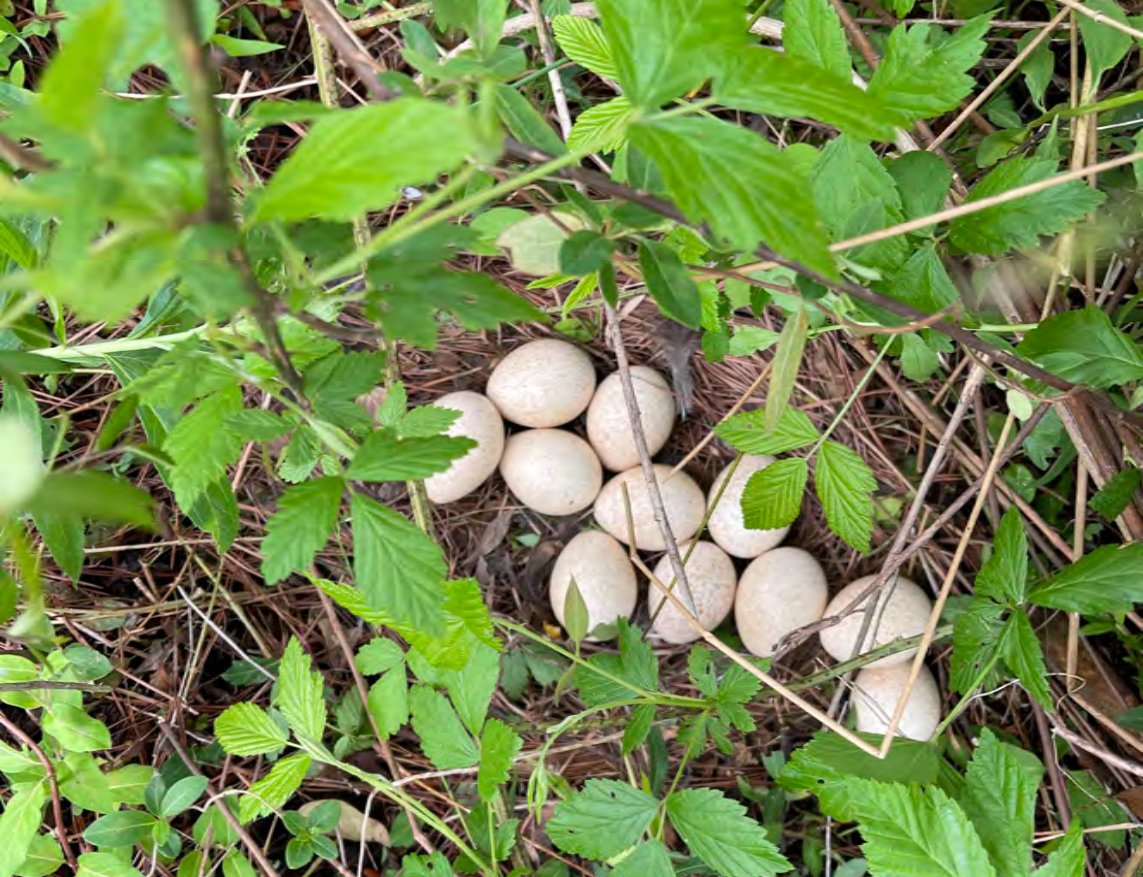
Are wild turkey populations declining? Like so many things in the field of wildlife biology the short answer is “it depends”. The more complete answer is it depends on where you are in the wild turkey’s range and how biologists are estimating population size in that area.
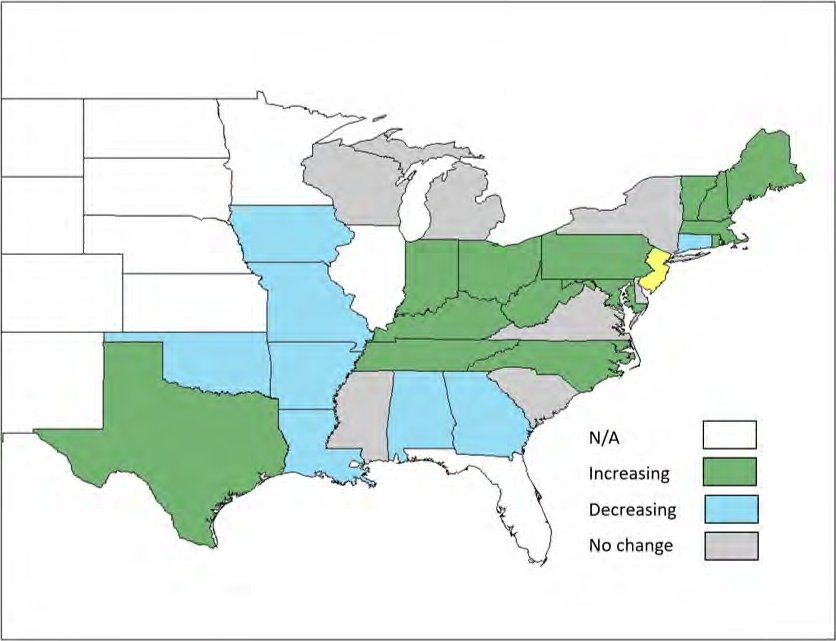
According to a recent report at the National Wild Turkey Symposium, spring harvest across all subspecies decreased 12% from 2014 to 2019, while turkey hunter numbers decreased an estimated 18%. In that report, 30 states provided population estimates for the eastern subspecies in both 2014 and 2019. Of those, eight reported a declining statewide population, one state was uncertain, seven indicated no change, and 14 reported an increase in abundance at the statewide scale (see figure). Most states with increasing populations tended to be in the Northeast or mid-Atlantic regions, with North Carolina and Tennessee being the only states from the South. An important caveat to those data is that, while the population in a given state may have increased from 2014 to 2019, most populations are still down from historic peaks in the early 2000’s.
Another important caveat to those estimates is how they are derived. Many states rely on hunter harvest as an index of population size. However, several factors can change the relationship between spring harvest and turkey populations. Decreasing hunter numbers, poor weather, or reduced hunting effort across the same number of hunters can all change the relationship between harvest and abundance. Furthermore, to improve population estimates, many states have implemented new harvest reporting systems or hunter surveys over the past several years. While this is an effort that should be applauded, it does complicate the matter of evaluating trends over time.
As a case in point, Mary Jo Casalena, lead turkey biologist for Pennsylvania, recently reported on the Wild Turkey Science podcast that Pennsylvania’s population peaked in the early 2000’s, as in most states. Formerly, they used spring harvest density (harvest/mi2) to track populations, and that method showed a declining harvest (and thus population) over the past 10 or so years. However, realizing that method was not accounting for the significant decrease in spring turkey hunters over the same time, Pennsylvania changed their analysis to incorporate hunter effort. As a result, the model showed that the long-term population trend at the statewide level is statistically stable, although declines were noted in some regions of the state. This uncertainty highlights the need for improved, standardized methods of estimating turkey populations, and justifies the push by turkey biologists to continue to evaluate existing monitoring tools and develop new ones. To put it bluntly, we still aren’t good at counting turkeys.
In the meantime, I regularly talk to landowners and hunters across many different states and regions who hunt a variety of properties and report that populations are down. Understandably, these hunters don’t care what the statewide data suggests when faced with one quiet morning after another in the spring woods. And, of course, nearly all of them have a pet hypothesis to explain the decline. Hunter harvest, predation, and habitat, or some combination thereof, tend to be the ones I hear most often, so I would like to spend some time discussing each, the data we have to address them, and the ongoing and future work designed to fill knowledge gaps.
Season timing
The current discussion surrounding the roles of spring season timing and harvest intensity in turkey population growth originated in Kurzejeski and Vangilder’s chapter on population management in Dickson’s book “The Wild Turkey: Biology and Management”, published in 1992. In that chapter, they note that Arkansas reduced the spring season by 1.5 weeks in 1984 by moving the opening date from April 1 to April 10, which was aimed at “…providing the opportunity for dominant gobblers to breed more hens before harvest…” Spring turkey harvest increased each year thereafter, from 4,509 birds in 1984 to 8,335 in 1991, despite the fact that annual harvest had been stalled for several years prior to the change. However, it is also important to remember that turkey populations and spring harvest rates were increasing during this period across several states with widely varying season frameworks.
In the same book chapter, the authors also cited a study published by Exum and others in 1987. Exum’s work took place on timber company land in south Alabama (Covington County), where they categorized hunting pressure as extremely high. Over the course of two years, 4/47 (8.5%) hens incubated infertile clutches. Three of those clutches were laid by juvenile females (jennies); however, researchers hypothesized that those infertile clutches were the result of an insufficient number of breeding males in the population. The authors documented no infertile nests during the third year of the study.
In 1999, Healy and Powell brought the issue of season timing back into the spotlight in a white paper titled “Wild Turkey Harvest Management: Biology, Strategies, and Techniques”. In that document they mention that “early seasons may lead to excessive harvest rates and a shortage of breeding males.” Citing both Kurzejeski and Vangilder’s book chapter and Exum’s paper as evidence.
A paper published in 2018, which was written by leading turkey biologists from several states, brought the season timing discussion into the 21st century. The authors cited Exum’s 1987 paper, along with another paper published in 2016, as evidence suggesting that populations with an inadequate number of breeding males may have poor productivity. Although the 2016 paper they cited did show unusually low nesting rates by hens when male abundance was low, that study was conducted on a series of sites in east Texas that were undergoing restocking. Specifically, of the four study sites included in the report, two had low nesting rates. No males were released on one of the two, and on the other adult males represented <10% of the male population, hardly representative of most turkey populations.
I know that’s a lot of technical history, but I think it is important in order to properly evaluate the current weight of evidence for the role of season timing in wild turkey productivity. To briefly recap, we have an anecdote based on a season date change in Arkansas with no experimental control, four nests in Alabama in the 1980’s, and low nesting participation on two sites that were undergoing restocking. Although I would consider that evidence weak, others have hypothesized that intensive harvest of males prior to breeding could affect other aspects of turkey reproduction.
For example, there is solid evidence from Texas and California that a subset of adult males, often referred to as dominant toms or gobblers, do most of the breeding. If those males are harvested prior to egg fertilization, some suggest that females, being choosy, take their time to reassess the remaining males before resuming mating. This, in turn, could delay nesting, resulting in poults being born during a less-than-optimal time of year. However, comparison of many historic and modern research reports does not show a shift in nest timing over several decades. Further, a paper published in 2010 showed that the dynamics of an unhunted turkey population on the Savannah River Site in South Carolina were comparable to those of hunted populations elsewhere.
More recently, preliminary data from Tennessee and Mississippi show no effect of season delays on turkey population dynamics. In Tennessee, researchers implemented a two-week season delay in five counties and found no difference in hatchability of eggs or timing of nesting in counties with the season delay compared to those that maintained status quo season dates after two years of monitoring. Mississippi took a slightly different approach, shifting the season opener back to April 1 on some wildlife management areas, each of which was paired with a control where the season remained unchanged. After four years, they have not noted any changes in the population relative to the number of turkeys encountered by hunters, harvest per unit effort, or the number of jakes encountered (an index of recruitment).
Could declines be related to density dependence?
An alternative hypothesis to explain wild turkey declines is density dependence. Briefly, density dependence is a fundamental concept in wildlife biology that describes the relationship between wildlife populations and their habitat. When populations are small, resources are nearly unlimited and population growth is exponential. As resource availability diminishes, the growth rate slows until carrying capacity is reached. We typically think of density dependence as it relates to white-tailed deer and food resources. However, density dependence can theoretically act on any number of factors, including availability of nesting and brooding cover for hens.
Mississippi was one of the first states to complete their restocking efforts, which occurred during the mid-1980’s. As in many other states, statewide harvest in Mississippi generally increased following restocking until the early 2000’s. However, fine-scale trends in harvest throughout the state varied, peaking first in south Mississippi (which was restocked first), then later in the northern portion of the state (which was restocked later). The same trend seems to have occurred regionally throughout the eastern U.S., with states that restocked earlier being the first to observe decreasing harvest. In contrast, states that restocked later, like Kentucky and North Carolina, have yet to experience significant declines in turkey harvest.
This hypothesis is backed by data. A paper published by Byrne and others in the 2015 National Wild Turkey Symposium Proceedings used historical productivity data, spring harvest data, and U.S. Geological Survey Breeding Bird Survey data to compare turkey productivity and population trends. They reported that productivity was negatively related to population size. Interestingly, they also reported that decreasing productivity was associated with an increasing number of hens without broods, rather than decreasing brood size. Further, they found an historical trend of increasing female survival, all hallmarks of density dependent processes. Accordingly, they hypothesized that quality nesting cover becomes a limiting resource as populations increase and more hens are forced to nest in suboptimal areas. Similarly, in a 2012 paper, the authors used 30 years of data collected by two independent survey methods to show a negative relationship between population size and reproduction in Georgia. Finally, a paper published in 1990 reported that poult recruitment in New York increased with decreasing population size.
The next obvious question is if density dependent factors have led to decreases in turkey abundance and, thereby, harvest, why don’t populations stabilize around some carrying capacity? Perhaps this is where the other factors I mentioned earlier in the article come into play.
Habitat
According to a 2015 study, the species with the greatest rates of habitat loss were those associated with grasslands, pastures, prairies, and open woodlands. That sounds a lot like prime locations to find and hunt turkeys. A major factor in habitat change across the Southeastern landscape was the 1985 Farm Bill. By 1992, the Conservation Reserve Program (CRP), which was part of the Bill, resulted in the conversion of 2.5 million acres of agricultural land to forest. Further, according to a 1997 paper, about 50% of the CRP acreage in the Southeast has been planted in pines; that number is as high as 75% in some states. Another 35% of CRP acreage was planted to exotic pasture grasses, mostly tall fescue. In total, fescue covers an estimated 35 million acres across the Southeast and bermudagrass, another exotic pasture grass, covers approximately 27 million acres. That’s a combined 62 million acres or, in other terms, almost three times the size of the state of Alabama.
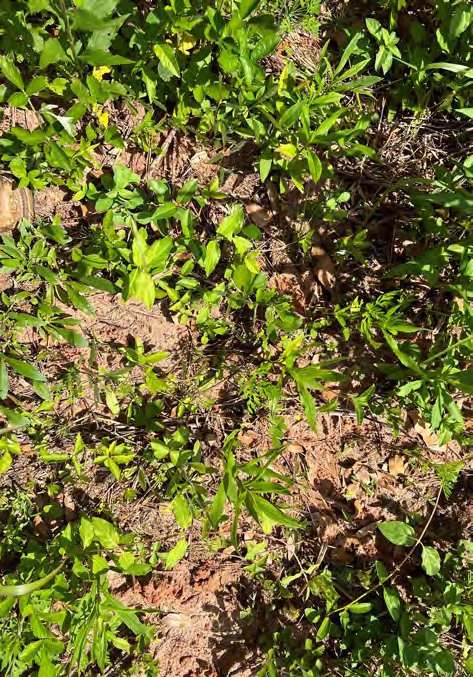
Although pine plantations can be managed to provide quality turkey habitat, many of them are not. Further complicating the issue is decreased demand for pine pulpwood, which means that many landowners are unable to get their stands thinned to provide suitable nesting and brooding cover for turkeys. And there is no doubt that dense, sod-forming grasses like tall fescue and bermudagrass have taken some of the best brooding and nesting areas we had out of turkey production. In fact, preliminary data from Dr. Craig Harper in Tennessee showed that early successional vegetation represented only 3% of the landscape in their study area, with another 4.5% in shrubland. Hens showed strong selection for these cover types, as almost half of the hens in that study nested in those areas (despite their limited availability), and nest success was significantly greater there.
Data from this and other recent work suggest that nesting and brooding (especially brooding!) cover are severely restricted across the modern landscape. From a turkey hunter’s perspective, this may come as a bit of a surprise, but ask any wild quail hunter and they’ll tell you this has been an ongoing battle for decades, as brooding cover for turkeys looks a lot like quail habitat. In addition to quail, prairie grouse, ruffed grouse, and pheasants are all declining because they’ve lost nesting and brooding habitat. Thus, it seems reasonable to conclude that turkey population productivity may have originally decreased over time as populations reached carrying capacity post-restocking, but has not returned to previous levels following decreases in abundance because the carrying capacity of the landscape is now lower.
Predation
I probably speak to more hunters who believe increasing predator populations, more than any other factor, are behind wild turkey declines. I think the reasons for that are many. Man has always had an adversarial relationship with predators, so our dislike for them is deeply ingrained within our DNA. I think it’s also easy to blame predators because it excuses us as hunters and managers to an extent. In other words, I’m not seeing fewer turkeys because I haven’t been managing my habitat properly or because I’ve been shooting too many birds, it’s because of predators.
There may be some truth to what those folks are saying. Without a doubt, there is way less trapping now than during the boom in the fur market. Knowing exactly how that has affected predator populations is difficult. Specifically, if most states don’t have a strong grasp on turkey numbers, how are they supposed to know how many raccoons, opossums, etc. they have? Additionally, how many folks were fur trapping during the early 2000’s when most states saw record spring turkey harvests? I would guess not many, but judging from what I see on social media, which I’ll grant you is completely anecdotal, I’m seeing A LOT of it going on now.
Unfortunately, we don’t have great data to estimate how those efforts are paying off. Despite the buzz around predator control for turkeys, there have only been a couple studies that addressed the issue; one by Dan Speake in Alabama in the 1970s, and another by Lovett Williams Jr. around the same time in Florida. Before briefly sharing those results, it is important to point out a few important differences between these studies and what the average landowner can accomplish. One is that both studies primarily relied on poisoned eggs to control predators, which is obviously illegal today. The other is that they were controlling predators across several thousand-acre areas, which far exceeds the average recreational property size and the ability to manage immigration from neighboring predator populations that goes along with it.

Regardless, Speake’s study did show that 55% of hens on predator removal areas had poults, compared to 24% of hens on untreated controls. Williams Jr. reported nest success was 72% on poisoned areas compared to 59% on untreated control areas. However, in Speake’s study, there were some years where poult-per-hen ratios were greater on untreated controls versus predator removal areas (but not in the same year). It’s also important to point out that turkey populations were always high on the predator removal area, even before trapping. Williams Jr. pointed out that during the years of poisoning, nest success was 72% on the poisoned area and 71% on the untreated control area; the differences between sites primarily occurred during the years of the study where no poison was distributed. Additionally, the greatest number of nests monitored on the predator removal site in a given year was 10, which is obviously a limited sample size.
Another issue that casts some doubt on the predator hypothesis is that if you compare nest success rates from modern studies to those in the past, we don’t see much difference. So, while the jury is still out, I think it’s safe to say that predators may be responsible for a small portion of the declines in harvest we’re seeing in some states, but I don’t think they are the primary culprit. One last thing I’d like for the reader to keep in mind is that habitat management IS predator management. Providing more abundant, higher quality, food and cover for turkeys can help mitigate predation.
Conclusion
I think all of us have an innate desire to simplify problems to the point that there is a single, actionable, solution. Oftentimes, I’m no different, but I don’t think that tactic is appropriate when it comes to the ongoing challenges in wild turkey management. Luckily, we are in the midst of a boom in wild turkey research, with more states and universities than ever working on various aspects of the problem. Hunter harvest, predators, habitat changes, disease, and other factors are all likely playing a role in what we’ve observed over the past 20-or so-years, but I am confident that within the next five years we will have the data to assess the relative contribution of each to turkey population dynamics, and the results will likely vary geographically. With that information in hand, we can begin the process of prioritizing initiatives to reverse declining population trends. In the meantime, I think it is important to keep in mind that we should be patient with state wildlife agencies who do as much as they can with the tools they have available. I think it is also important that all of us do what we can where we can. Maximize brooding and nesting cover, keep spring harvest reasonable, and avoid practices likely to supplement predator populations or concentrate their movements. If we all do this, perhaps we can start moving the needle, even before the results are in.