
In today’s fast technology, global reach world, everything is expected to happen immediately after little or no effort. We push the norm to the limit and demand fast, easy results. Our attention span simply does not allow time for things to take their course and come to fruition.
The fast-track approach may find success in some fields of endeavor but seldom works in wildlife management. Biologists and researchers have proven that the key to success in growing trophy whitetail deer is age + genetics + cover + nutrition = trophy whitetail bucks.
Age is easy, just don’t shoot young bucks. Genetics are what they are in free-ranging herds but some think culling inferior deer helps. Cover can be manipulated by timber practices and management of native vegetation. Nutrition can be supplemented by planting nutritional plots and feeding high protein feeds.

One item in the trophy buck recipe that is often overlooked is minerals and the availability thereof. Growing antlers are composed of 80% protein. Mature antlers are roughly composed of equal amounts of protein and minerals. Calcium and phosphorous are by far the most common minerals in antlers, composing 30-35 percent of mature antlers.
According to the Quality Deer Management Association, 11 different minerals can be found in whitetail deer antlers. Calcium is the most prevalent mineral and comprises 19% of antler weight. Phosphorous comprises 10% of dry antler weight followed by magnesium at 1% and sodium at .5%. Lessor amounts of potassium, barium, zinc, iron, aluminum, strontium, andmanganese are also found in antlers. Other than calcium and potassium, little is known about the role of minerals in antler growth.

Whitetails have the ability to bank minerals and transfer them from the skeleton to growing antlers but only a small portion of minerals needed for optimum antler growth is obtained through this process. The rest must come from diet or supplements.
Minerals are also important to does. During gestation and lactation does have high requirements for calcium and magnesium. It has been found that milk production requires almost 80% of a doe’s sodium intake. It is also thought the high concentration of potassium and water in spring forage creates a sodium imbalance that causes deer to seek salt. Salt is the attraction to mineral sites and masks the bitter taste of other beneficial minerals.
Mineral Facts
There are 65 minerals recognized by experts. These minerals are found in the soil and plants and are required to some extent by all living animals. They are classified as macro minerals and micro minerals. Macro minerals are present at larger levels in animal bodies or required in larger amounts in the diet. Micro minerals are often referred to as trace minerals, meaning they are present in smaller amounts in the animal’s diet.
It is widely recognized that calcium, phosphorous and potassium are minerals important to antler development in whitetail deer. Most mineral products marketed today feature a high content level of these minerals. Minerals have a bitter taste and sodium (salt) is the attractant that encourages deer to consume minerals at man-made sites. What is not entirely understood is the role played by other minerals in antler development and animal health.
In a perfect world, deer and other wildlife acquire essential minerals from consumption of plants and water. Problem is, in today’s world, modern farming practices have stripped the land of critical minerals necessary for maximum antler development and overall animal health.
The Expert
Redmond Hunt is a company that specializes in minerals for wildlife. Trophy Rock™ is the name of their flagship product. This product is a natural sea salt mined in America and sold in 12- or 20-pound rocks. It contains all known minerals and performs as a lick site that deer are naturally attracted to. From this base other products have evolved.
Plot Rock™ contains the ingredients found in Trophy Rock™ and is designed to be used in conjunction with commonly used fertilizers. Plants take up the minerals and as deer consume the plants, they get minerals required for antler growth and overall health.
Hydro™ is designed to be mixed with water. This turns the water alkaline and mineralizes it making it healthy for deer and other wildlife. It has to be used in a man-made tank because the ratio of water to product is very specific.

Gene Price works in the Public Relations and Marketing arm of Trophy Rock and offers this advice. “If you look at minerals and listen to the information available today, there are the big three that everybody recognizes; phosphorus, calcium and potassium. In my opinion any of the 65 minerals are just as important as the other. If you don’t have the other minerals to support the big three, they don’t work right. The body can’t take them in and utilize them effectively. Without the entire spectrum on minerals, certain minerals are lost in the digestive cycle and are not properly incorporated into the blood.”
“We strive to get the blood back to zero. In most animals there is a negative value of multiple minerals. We don’t try to overload it or push for extreme levels of any mineral. We believe a zero value is the natural level of minerals in the bloodstream. We don’t want to see negative levels of any mineral and believe this is the basis for healthy deer. It’s like a big spider web. This mineral helps that mineral and that mineral helps those three minerals. We will probably never understand it fully but we know it is essential that all known minerals are available,” said Price.
The Big Picture
The implementation of a mineral supplement program is often abandoned because the manager or landowner does not see immediate results. Truth is, results come gradually and are difficult to see in the early stages.
As with all things in wildlife management, very few things happen quickly. Subtle changes can be seen early on if you are truly in touch with your deer herd. Better fawn recruitment, slicker hair coats, increased body weights and overall health of the herd are a few of the recognizable changes early on in a mineral supplementation program.
“The real results can be seen over a generation. If you compare a five-year-old buck that is mineral deficient to a five-year-old buck that is mineral balanced the differences are significant. Larger antlers and heavier body weights are the most noticeable differences but better fawn recruitment and overall health of the herd is also dramatically improved,” says Gene Price.
“The key to success is to be patient and consistent with the program. Deer have an uncanny ability to regulate mineral levels in their blood. Negative values of certain minerals in deer create the aforementioned problems. There is also the possibility of a positive level of certain minerals. Neither is good. For example, excess calcium in humans causes problems such as kidney stones, gall stones, bladder stones and calcium deposits in arteries and blood vessels. Fecal studies have shown that excess minerals found in the bloodstream and digestive system of deer are passed out of the body. These studies support the theory of a deer being able to regulate retained amounts of minerals in their body.”
Create a Mineral Site
We have all seen the big hole in the ground created by deer searching for salt or minerals. Some of these sites are natural outcroppings of minerals but many are man-made in an effort to attract deer and provide their mineral needs.
Gene Price offers this advice: “When you see a huge hole in the ground covered with deer tracks and droppings, those deer are eating dirt to get the minerals. Eating dirt is not what we think is good for deer. The same applies to mineral sites established on a stump or log. To get the minerals deer are eating wood. Again, not a good thing in our opinion.”
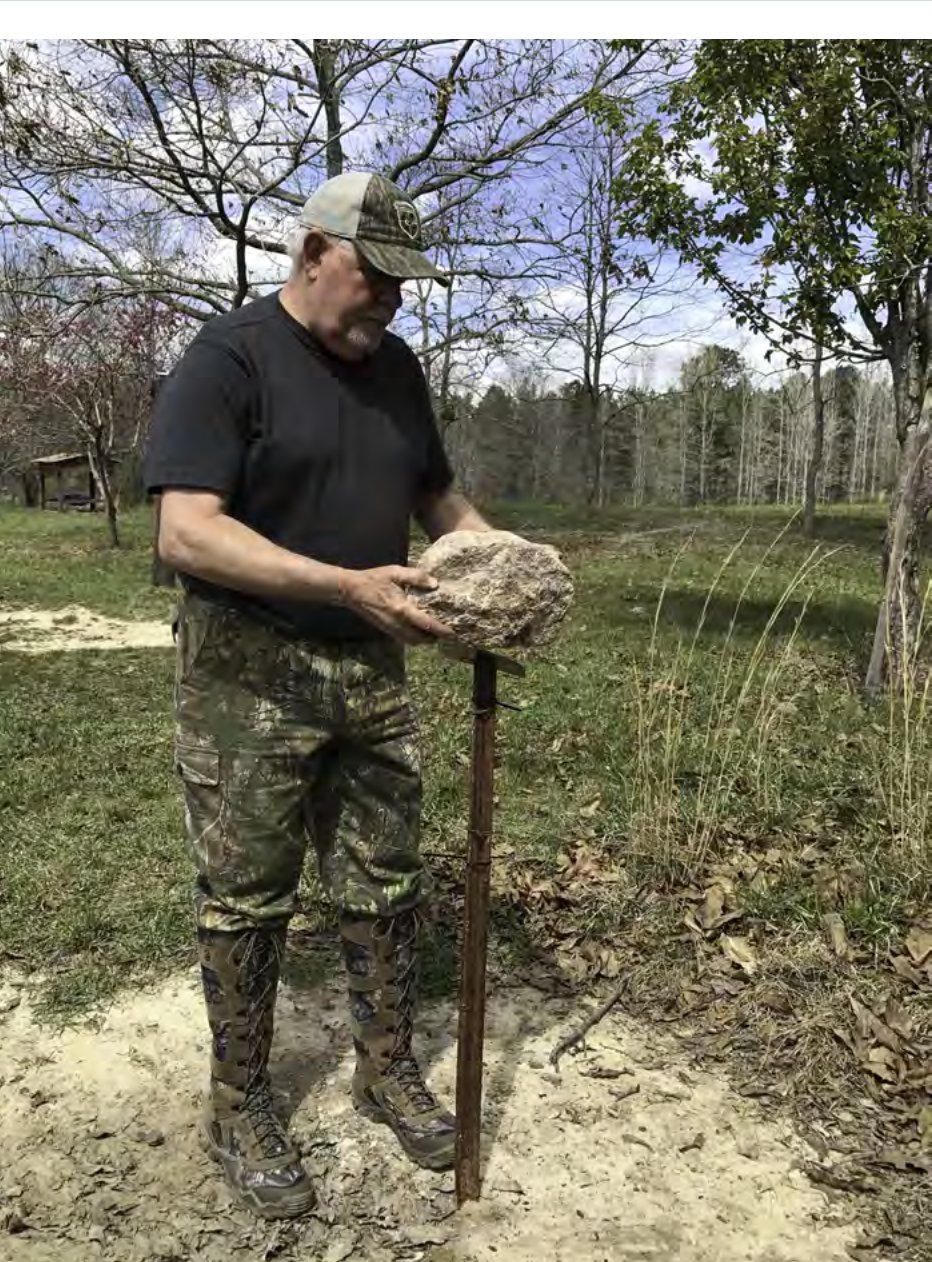
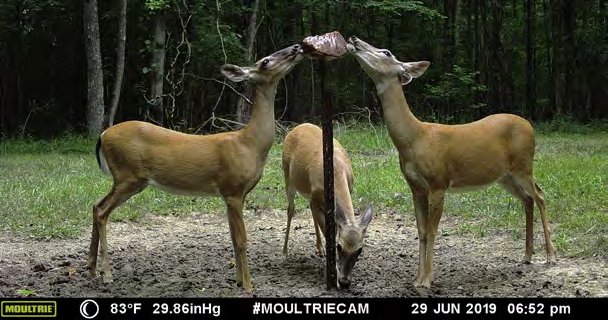
“We recommend using a T post or piece of rebar to get the mineral off the ground. Elevating a Trophy Rock eliminates deer eating dirt or wood to obtain the minerals they need. The rock will last longer and the minerals will be more accessible to deer,” said Price.
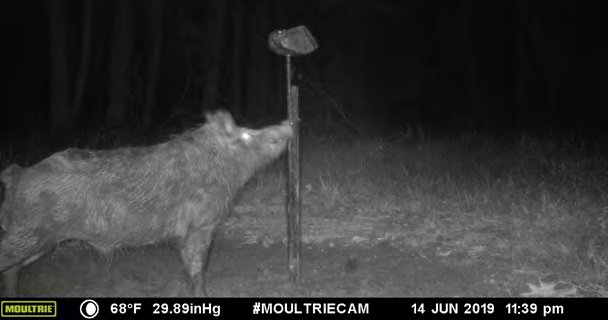
On our east-central Alabama farm, feral hogs are a huge problem. Elevating a Trophy Rock keeps the rock out of the reach of hogs and prevents it from being rolled away from the established site.
Over time, rain and moisture will leach some of the minerals found in the rock into the ground beneath it. Trail cameras prove a myriad of wildlife takes advantage of the minerals. Turkeys, raccoons, squirrels, rabbits and songbirds frequently visit the site to take advantage of the available minerals.

The Reality of It All
There have been multiple studies conducted on the effect of mineral supplementation on whitetail deer at universities such as Mississippi State, Penn State and Auburn University. None of these studies conclusively proved that mineral supplementation contributed to larger antlers. However, the Mississippi State study did suggest that phosphorous contributed to larger body size.
Despite the lack of scientific proof that a mineral regimen increases antler or body size in deer there are definite advantages that can be readily seen. Mineral sites are excellent locations for trail cameras. In spring and summer, the sites are heavily used by deer and other game animals. Trail camera photos provide insight to wildlife populations on your property. They also provide an excellent opportunity to inventory the bucks using your land.
Almost all soil 25-50 miles from a seacoast is sodium deficient. In these areas salt may be just as important to deer as calcium and phosphorous. In spring and summer deer suffer a sodium deficiency due to high water and potassium content of vegetation and forage. This interferes with a deer’s ability to convert sodium in the body and increases the need for sodium. A University of Tennessee study concluded that mineral sites high in sodium content were visited by deer four times more often that mineral sites low in sodium content.

The reality of it all is that mineral supplementation, especially calcium, sodium and phosphorous, can be beneficial to whitetail deer. This is especially true in areas with mineral deficient soils or where deer are nutritionally deprived. None of this replaces the fact that age and nutrition are the main factors in producing bigger bucks.
If your management practices have addressed habitat and herd management concerns a mineral supplementation program is a logical next step. Remember, improvements will be over time and slow to materialize. Be consistent and make your mineral program a year-round endeavor.
Scientific studies have not proven minerals will boost body weight and antler size in your deer herd but neither have they proven any disadvantage. Mineral licks are fun to establish and monitor. They are a definite attraction to wildlife on your land and just might be the key to growing, attracting or holding a trophy buck on your property. You already do everything you can for the health of your wildlife. Minerals are just another opportunity to provide what your wild critters want and need!
A lot has been said about the use of minerals at lick sites by deer and other wildlife. Little has been said about providing essential minerals through water or supplemental feed. Here are some options you should consider.
For the past decade my wife and I have done everything we can to improve the population, health and quality of native wildlife on our small east-central Alabama farm. Mineral supplementation has been a part of that effort and seemed a natural progression to timber, native habitat, food plot and herd management.
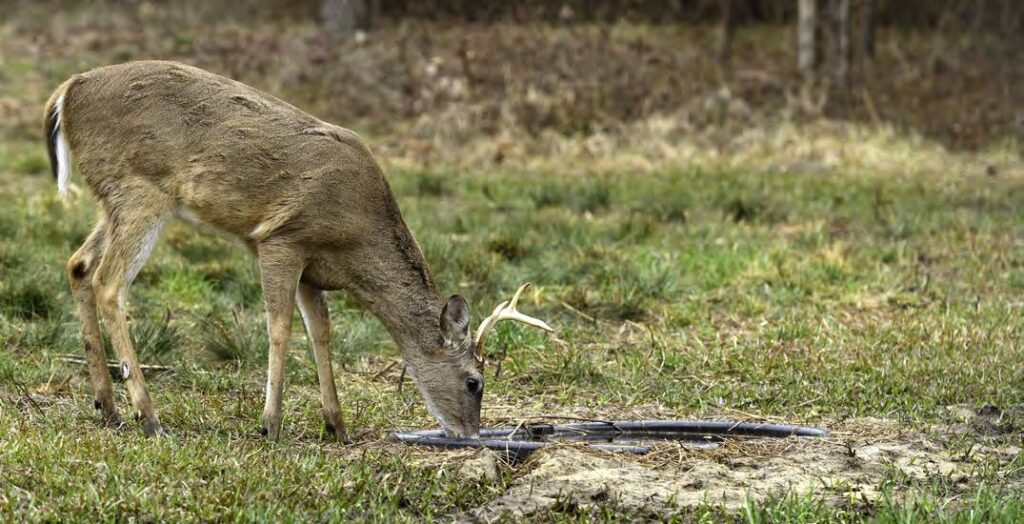
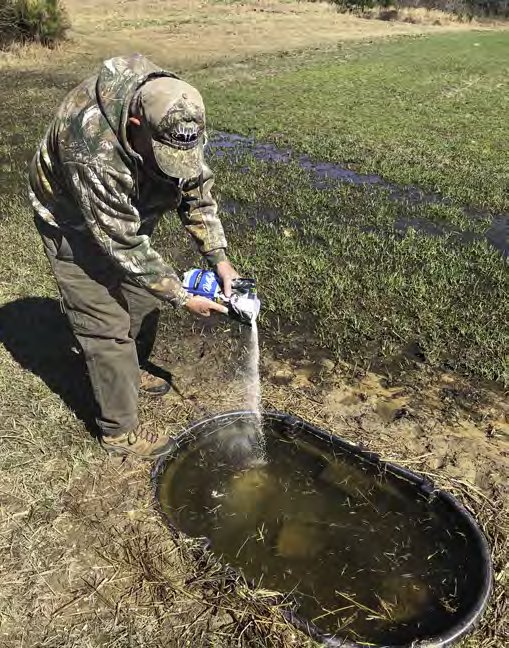
Recently, we installed a mineral water site in an effort to better provide what we feel our wildlife needs. We began by purchasing a 50-gallon fiberglass tank from a local feed store. We chose a central location on the farm and dug a hole the shape of the tank deep enough to install it level with the ground.
We filled the tank with water and added Trophy Rock Hydro to the tank at one pound of Hydro per 20 gallons of water. The Hydro turns the water alkaline and provides essential minerals for overall herd health.
It took a while but deer and turkeys eventually began utilizing the water source. As the water is consumed or evaporates from the tank, replace it with more water and add one-pound Hydro to every 20 gallons water lost. This will maintain sufficient water level in the tank and proper ratio of mineral to water.
Over time, slime will form in the tank. This is a natural occurrence and does not affect the desirability of the water to wildlife or harm them in any way. If the slime bothers you, you can remove most of it simply by dipping it out.