
February/March 2014
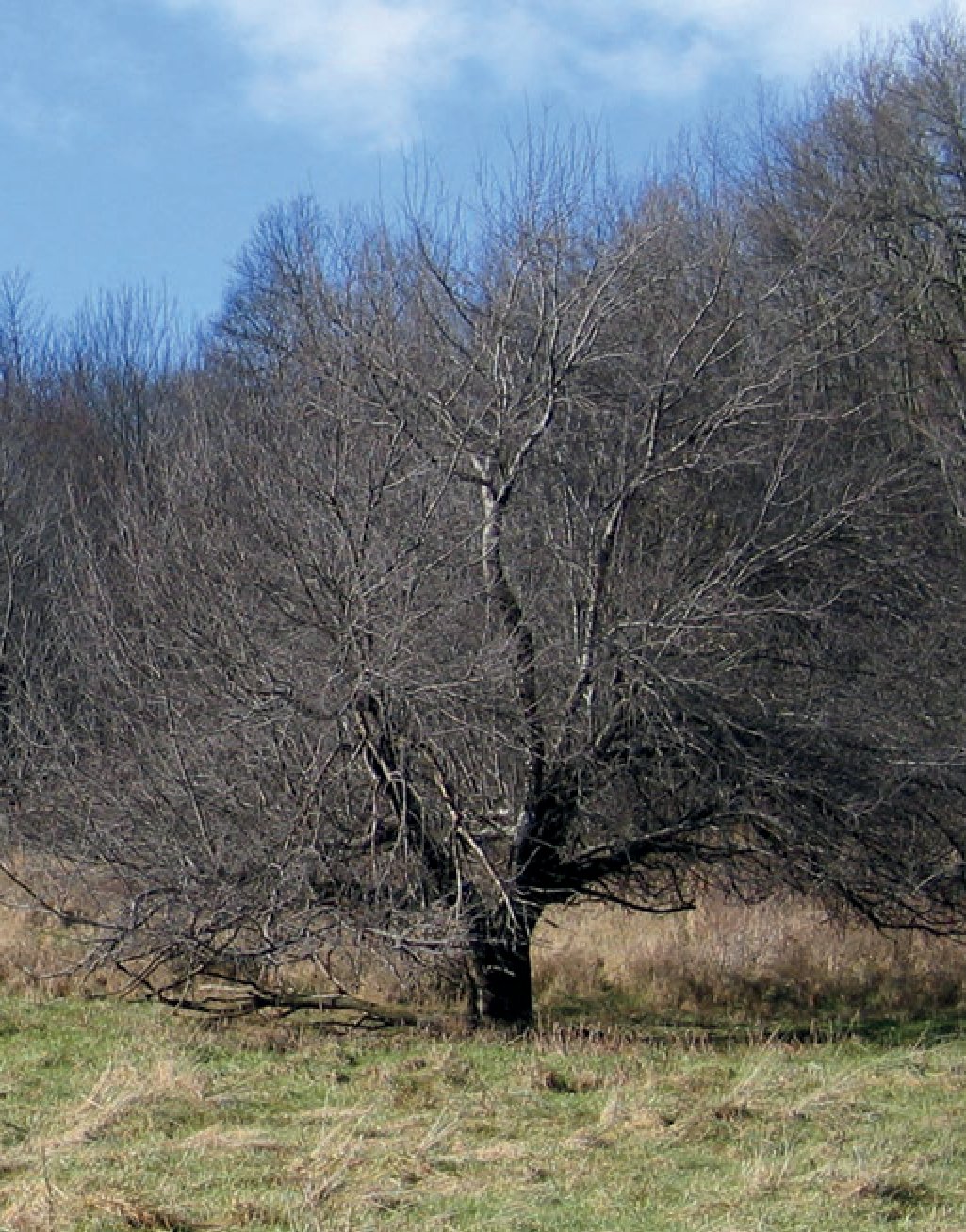
Prune apple trees.
Pruning is a management strategy that will improve the health of apple trees as well as enhance fruit production. Moderate pruning is usually best. Heavy pruning dwarfs trees and may delay fruit bearing, and is especially undesirable for young trees. Proper pruning shapes the tree’s structure for life. Prune young trees to establish a strong scaffold system with wide-angled, well-spaced branches that will not split from high winds or heavy crops. A well-trained young tree bears heavy crops early and continues to bear efficiently. The dormant season is the best time to prune fruit trees, although dead or diseased branches may be removed any time. Prune bearing apple trees regularly, preferably every year; it is a mistake to neglect trees for years and then prune them severely. Old trees, however, can sometimes be rejuvenated with heavier pruning than younger trees require.

Plan and schedule timber harvest activities
If you have timber that needs to be harvested, cutting it during the dormant season (winter) or early in the growing season (spring) enhances its wildlife value during the first year after the harvest. Harvesting timber during this period gives plants the entire growing season to regenerate resulting in increased desirable food and cover for wildlife. Conversely, if timber is harvested in the middle of summer (mid-growing season) plants do not have as much time to germinate and grow. Thus, the resulting vegetation will not provide as much benefit to wildlife. Obviously, local timber markets and timber prices play a significant role in the decision to harvest timber, but if markets are right, harvesting during winter or spring will increase the wildlife value of the area during the first year.
Plant supplemental fruit trees and/or other wildlife friendly plantings.
Supplementing your property with plantings of oaks, chestnuts, pears, crabapples, plums, autumn olive, etc. is a great way to enhance both the aesthetics and wildlife value of your property. Late winter through early spring (before spring green up) is the best time to plant most wildlife friendly trees/shrubs. Planting a variety of trees/shrubs will ensure that a variety of food sources are available throughout the year. The plantings should be strategically placed around food plots or fields, along roadsides/ intersections, or other areas that will receive adequate sunlight. If quail management is one of your goals, and your property has lots of open land, you may consider establishing hedgerows for additional quail habitat. Hedgerows are often created using wildlife friendly plantings such as plums, drawf chinquapin or sawtooth oaks along with other shrubs. Hedgerows can be enhanced by planting adjacent strips of partridge pea or food strips of corn, Egyptian wheat, sorghum, or millets this spring/summer. The Wildlife Group is an excellent source for obtaining beneficial wildlife trees/shrubs as well as getting advice on planting strategies and tips.
Deer stand preventative maintenance
While it is not a fun job, deer stand maintenance will prolong the life of stands and their accessories and in some cases will prevent tree damage during the growing season. Things such as removing seat cushions, camo wraps, shooting rest padding, and/or actually pulling deer stands out of the woods and storing them out of the weather will significantly increase their life and save money in the long run. Squirrels and Mother Nature can and will ruin a deer stand in as little as one season. Taking the time to label parts (cushions, wraps, ladder sections, etc) will help keep loose items “marked” and make reinstallation next fall much quicker and easier. Before storing stands for the summer, I check them for needed repairs, touch them up with paint, and lubricate any moving parts. This helps protect the stands but also allows time for the odors associated with paints and oils to fade before next fall. If you have enclosed shooting houses, take time now to close windows, doors, and make attempts to “seal it up” where needed to keep unwanted pests out. While exterminating a few wasps is easily done next fall, removing 6 months’ worth of owl droppings is another story! If you plan to leave ladders and lock on stands in the woods over the summer be sure to loosen the fasteners, straps, or chains that attach them to the tree to allow room for the tree to grow during summer. You may be amazed at how fast a tree can “absorb” (grow around) a chain! As a side note, while in the area, I often use this time to do a little scouting for next hunting season as well.
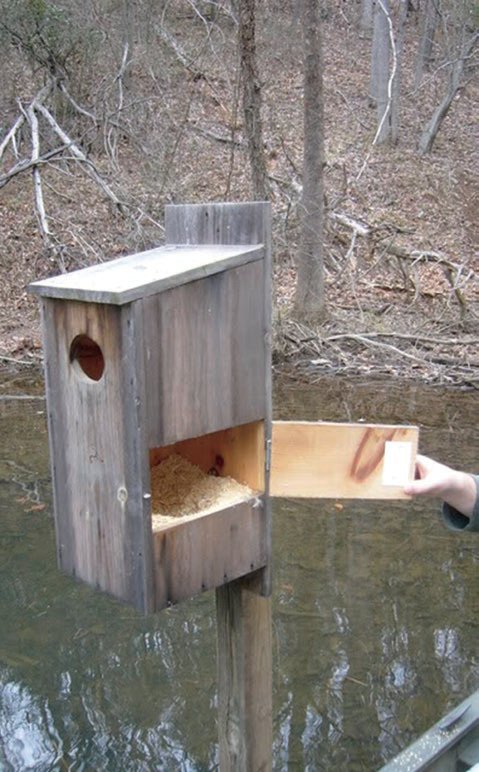
Erect new wood duck boxes and/or clean out existing boxes in preparation for the nesting season.
Place 4″-6″ of sawdust or wood shavings in the bottom of the box for nesting material. I prefer shavings verses sawdust because they do not absorb moisture as easily which causes rotting and mold – check with a wood shop that uses a planer for shavings. Cedar chips that are used for dog bedding can be good nesting material as well. Erect new boxes before February in highly visible areas near good brood rearing habitat. Adequate protective cover is essential for brood survival. Brood habitat should include a dependable source of water with plenty of shrubs and emergent vegetation for food and cover. These areas are generally along the perimeter of a pond or swamp. Wood duck boxes should be cleaned out and inspected at least once per year. Word of caution – always be careful when opening wood duck nest boxes. Many other animals use the boxes. Animals that are commonly found in wood duck boxes include gray squirrel, flying squirrel, rat snakes, screech owls, and flycatchers. Building wood duck boxes, putting them out, and checking them after nesting season to monitor usage is always an adventure and gratifying. This is a great project to include children. There is a lot of hands on work and makes them feel good about helping animals…plus it teaches them good stewardship.
Provide supplemental feed for deer.
This recommendation/activity is directed towards landowners or managers who have done a good job managing natural habitat, food plots, and deer herd conditions. That is, before thinking about starting a supplemental feeding program for deer on your property, you need to take care of the “important” things first. In other words, you cannot hang shutters if you do not have a house – and you will not grow big bucks and a healthy herd with supplemental feed alone. It is a supplement to other management strategies and activities. However, when done in combination with other core management practices, supplemental feeding can be valuable for deer. Be sure to check your local game laws before providing feed on your property. Many states do not allow the use of feed during hunting season. Ideally, providing supplemental feed throughout the year is best, but supplemental feed will be most used and most valuable for deer in late winter and late summer. These are periods when natural food availability is at its lowest. So if you have a limited budget and can not or do not want to feed throughout the year, provide it during the periods deer need it most.
Initiate late winter/early spring strip disking
Are you looking for an inexpensive management strategy that can significantly improve the wildlife value of your property? Strip disking is an excellent management practice that can produce exceptional food and cover for various wildlife. If you have a tractor and a disk the only expenses of strip disking are fuel and time. Simply find areas within relatively open habitat, drop the disks, and drag them. Obviously, the tractor operator needs to pay attention to avoid stumps or other obstacles to prevent damaging the tractor or disks. The goal is to just “stir” the soil to promote germination of seeds in the natural seed bank. Generally speaking, one pass is all that is needed. Disking can be done along roadsides, in or around old fields, and within thinned pine plantations or mature longleaf stands. Disking strips 10-30 feet wide in late winter and early spring will stimulate the growth of desirable native quail food plants such as partridge pea and beggarweed. The new succulent vegetation that grows in the strips will also attract insects. Late winter – early spring is also the best time to disk to promote high quality deer browse as it promotes broadleaf weed growth. These areas can be managed by re-disking every other year. The time of year you disk will influence the types of plants that colonize. For example, winter disking produces heavy-seeded quail foods such as partridge pea and ragweed, while disking in April increases the production of important seed-producing grasses such as panic grass. Disking in June favors grasses and green vegetation that attract insects and a number of major seed plants that turkeys and quail readily feed upon in the fall. In general, seasonal disking can provide a diversity of seed producing plants for quail and turkeys as well as quality browse plants for deer.
Spring is a good time to check soil pH and apply lime to food plots if needed.
To check the soil pH, simply collect soil samples and send them to a soil laboratory (see previous Wildlife Trends articles on how to properly collect soil samples). Your local farmers cooperative will often have soil collection bags (which normally have directions on how to collect soil samples) and will also know where you can send the soil to be tested. Although there are exceptions, most crops grow best in a relatively neutral soil pH of 6.5 – 7.0. Thus, lime is often needed to enhance the soil. Because it can take several months for lime to effectively change the soil pH, checking the soil in the spring will give you ample time to enhance the soil before the fall planting period. Remember, ensuring proper soil pH is often more important than what you plant or how much you fertilize. In fact, proper soil pH is essential for fertilizer to be available to the plants. Although lime can be spread any time of year, applying it at least 6 months before planting will allow time for it to enhance the soil. Lime can be broadcast directly on the soil where rain can work it into the growing zone of the soil, but disking it into the soil will speed the process up and is recommended.
Mow early or wait until early summer.
If you have areas that need to be mowed, mow them before turkey nesting season (which is generally March-May in most of the Southeast) to prevent destroying nests. Unless necessary, I recommend leaving as much of roadsides, fields, and other openings unmowed to provide additional nesting habitat for turkeys and other birds. Much turkey nesting research shows that these areas are valuable and heavily used for nesting by hen turkeys. Even if turkeys do not use all of the un-mowed areas, these areas will host an alternate food source (small mammals – rats, mice, and rabbits) for potential turkey nest predators. Having this “extra habitat” also increases the “search area” and reduces predator success in finding turkeys and their nests giving turkeys a better chance of producing a clutch and surviving. This strategy is more valuable for landowners whose property has limited nesting habitat.
Make preparations for spring turkey season.
One of the best ways to ensure you have gobblers in the spring is to manage your property throughout the year to promote quality nesting cover (see Turkey Habitat Management article in the January-February 2009 issue for more detail on creating nesting habitat). I have worked with many landowners who had gobblers on their property most of the year, but they disappeared during the spring. After closer inspection, their property didn’t have good nesting habitat and the hens had moved to adjacent properties carrying the gobblers with them. Quality nesting habitat is created by maintaining a patchwork of early successional habitat throughout your property. Burning, herbicide applications, strip disking, timber harvest, and roadside management strategies are all tools that can help you create quality nesting habitat for turkeys. Besides the key element of creating nesting habitat, creating strutting zones in strategic areas around your property will help put turkeys where you want them to be. February or early March is a good time to create strutting areas. A mower, disk, fire or combination of these are the tools of choice for this task. Fire is my preferred tool if it can be used. Strutting areas are simply areas that have relatively little or open ground cover that will be attractive to turkeys for breeding courtships. I often create these areas between roosting and nesting areas and preferably near a food source such as an old field, chufa patch, or food plot. Areas that often lend themselves well to creating strutting areas are powerlines, old fields, food plots and roadsides. Lastly, mowing hunter access trails will help you slip into areas to hunt without making a bunch of noise. If these trails go through thick habitat, don’t be surprised if turkeys use the same trails.

Assess management strategies, review or develop a plan, & prepare for upcoming projects.
Good planning and preparation ensures you will have everything needed and be ready to initiate projects this summer. I heard a saying that has stuck with me over the years that always reminds me to plan – “People don’t plan to fail, but often fail to plan”. Planning also allows you to prioritize projects, create a budget for the upcoming year, and develop timelines for completion to help you stay on track. Many landowners simply tackle projects as they come up or as they think of them. This strategy can work, but without planning they may overlook or run out of money before addressing a more needed project. Spring is a busy time for us at Tall Tines Wildlife Consultants helping landowners determine their property’s needs. We conduct what we call “property management assessments”. During this consultation, we review projects that had been completed the previous year, review harvest data or other information that provides insight to how the wildlife we are trying to manage is responding to management, re-assess progress towards goals, assess the habitat and property in general to determine its limiting factors, and develop a prioritized list of activities that need to happen to help the landowner achieve their goals. While this is a professional service we provide, it is a process that I feel all landowners should go through each year, whether they hire a professional biologist or not, to keep them on track and moving forward.
Comparison of responses to rate and date of drawdown on waterfowl impoundments
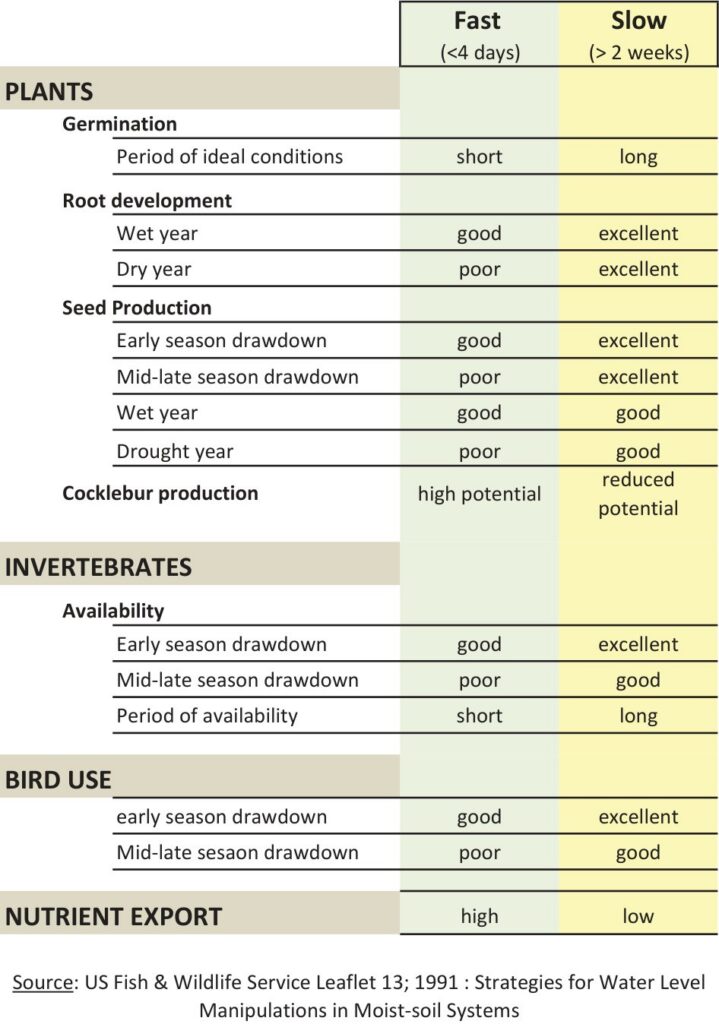
Source: US Fish & Wildlife Service Leaflet 13; 1991 : Strategies for Water Level Manipulations in Moist-soil Systems
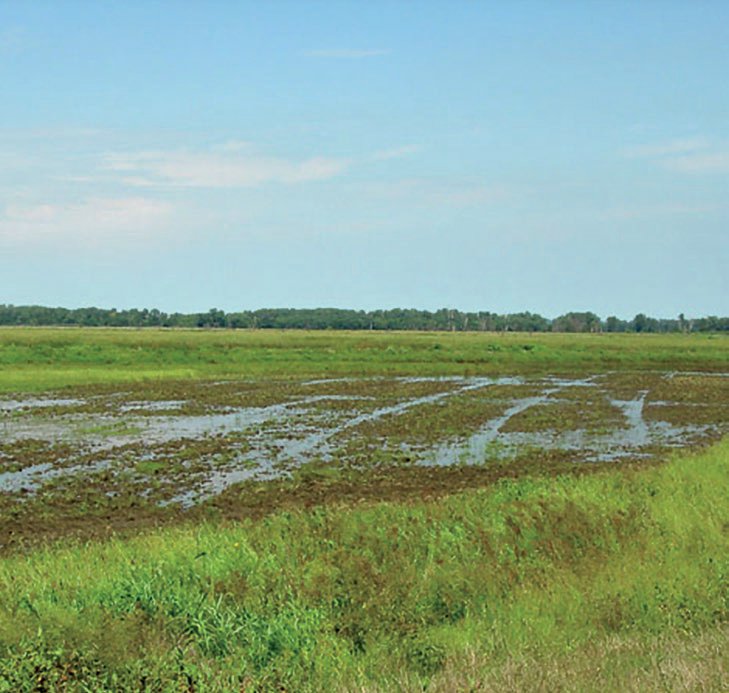
Manage water in duck ponds.
Although duck season may be over, leaving your duck ponds flooded will benefit migrating waterfowl by providing energy rich foods for their flight back north. Pond drawdown rate and timing is important and will vary depending on your management strategy (natural moist soil management or agricultural plantings). If you are planting agricultural crops for waterfowl, leaving the pond flooded through early summer will help control weeds. Just be sure to drain the pond early enough to allow adequate drying time before planting time. However, if you are managing for natural moist soil plants, such as in a beaver pond or waterfowl impoundment, you will need to start pond drawdown in the spring to allow desirable native moist soil plants to germinate and grow. Slow drawdowns (over a 2-3 week period) are often desired because they will result in diverse emergent wetland species and invertebrate composition. Quick drawdowns result in decreased plant species diversity and are often composed of undesirable species. If you are managing a GTR (Green Tree Reservoir or flooded hardwood area), use a slow drawdown process but ensure water is off the area before spring green up to protect/ enhance growth of oaks in the GTR. Some oaks, particularly the more desirable ones for generating duck food, do not do well if left flooded after they begin growing leaves in the spring.