

Of all the wonders of nature, perhaps the most fascinating are hummingbirds. There are over 200 species of hummingbirds in the Americas but as few as two dozen venture into North America. In fact, there are 12 species of hummingbirds that can be seen in Alabama, but by far the most common one in Alabama is the ruby throated hummingbird. Since the ruby throated is the one you are most likely to see, we are going to focus on some interesting facts and tips that will help you attract and hold them in your yard or property.
Ruby throated hummingbirds (archilochus colubris) are solitary by nature. They are only social during courtship, which lasts only minutes. Males and females are aggressive towards other hummingbirds and defend their territories by chasing or attacking other birds that enter their space. They also attack other larger birds such as jays, crows or even hawks that infringe their territory. These aerial displays are fun to watch and make hummingbirds very popular additions to any backyard wildlife viewing.
Make Your Yard a Hummingbird Destination
Hummingbirds have a tiny, pea-sized brain that is large compared to the body size of the bird. This brain allows hummers to remember where it found flowers or feeders for food in the past by using visual landmarks. Hummers have 8 power vision and can see feeders from as far as 3/4 mile away. Their exceptional eyesight allows them to locate flowers and insects overlooked by humans.
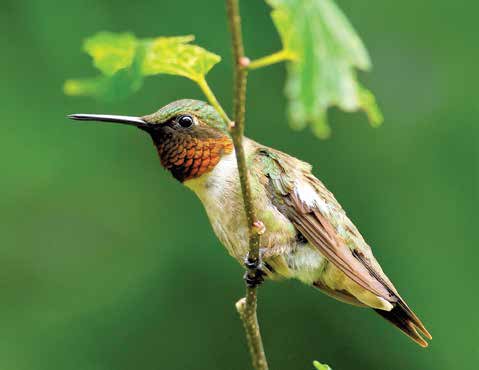
It was once thought hummingbirds drank nectar by sucking it up similar to drinking juice through a straw. We now know that is not true. The long beak allows the bird to reach deep into a flower where the tongue does the real work. The bird licks up the nectar with its long, thin tongue. This action is similar to a dog lapping up water. Not much nectar makes it to the bird’s mouth with a single lick but the ability to lick 13 times a second makes this feeding method effective.
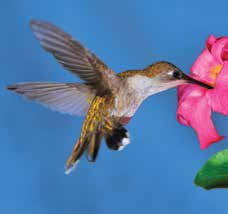

If you are interested in attracting hummingbirds to your yard there are several things you can do to make that happen. Hummingbirds are attracted to bright colors, red and orange in particular. Flowers such as lantana, salvia, butterfly bush and honeysuckle are a few that can be planted in your yard to attract hummingbirds. These flowering plants provide more than just the nectar hummingbirds need. They provide the insects hummers need for essential nutritional elements.

Hummingbird feeders can be purchased at many retail outlets. They come in all shapes, sizes and price ranges. These feeders are very attractive to hummers and provide a reliable food source. There is, however, a degree of responsibility that comes with operating and maintaining hummingbird feeders.
Clean feeders are important to the health of hummingbirds. When the weather is hot the sugar water should be changed every three or four days. Clean the feeder each time you change the sugar water by using a brush and hot tap water. At least once a month thoroughly clean the feeder with a mixture of 1/4 cup bleach per gallon of water. Soak the feeders in the bleach solution for one hour, then scrub with a brush. Rinse thoroughly and dry before refilling with sugar water.
Tips on How to Attract Hummingbirds
Hummingbirds naturally rely on flowers for food. Flowers provide nectar that contains 55% sucrose, 24% glucose and 21% fructose. This blend of nutrients is more than adequate for the needs of these little high-metabolism feathered helicopters.
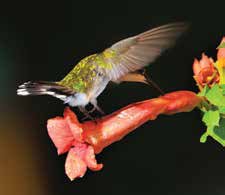
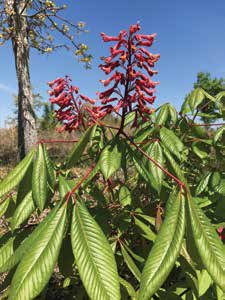
Honeysuckle, lantana, butterfly bush, coral bells, irises, lilies, petunia, salvia and trumpet vine are plants you can add to your backyard landscape that attract and hold hummingbirds.
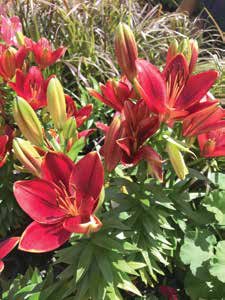
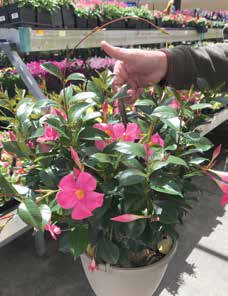
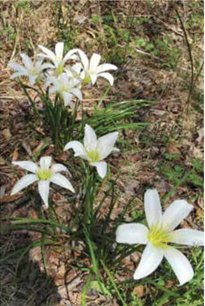
Sugar water filled feeders allow people to observe and enjoy hummingbirds but may cause hummers to not seek natural food sources like blooming plants thus reducing the amount of pollination their feeding provides. Therefore, keep the number of feeders reasonable and provide plenty of flowering plants.
One-part sugar to four parts water is the standard mixture for hummingbird feeders. White granulated pure cane sugar is recommended. Some believe a higher percentage of sugar, 35%, is even better. Hummers tend to more aggressively defend feeders filled with nectar mixed at a 1-part sugar to 3 parts water. This could indicate a preference for higher sugar content in a feeder mix. Organic, brown or raw sugar could contain harmful ingredients such as iron, agave syrup or molasses and should not be used. Honey should not be used because when diluted with water harmful organisms grow in it causing it to quickly spoil.
Red dye was once thought to help attract hummers to feeders but is unnecessary. Use feeders with bright red or orange colors to attract birds. A brightly colored red or range ribbon tied nearby also helps birds locate your feeders. A combination of feeders and naturally attractive plants are the best way to attract and hold hummers.
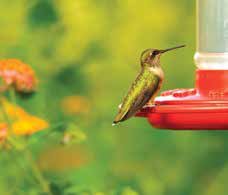
Another appealing feature to add is a good water source. A fine mist sprayed into the air is particularly attractive to hummers. They dart in and out of the spray for a quick drink or bath.
For more info on attracting hummingbirds visit http://www.hummingbirds.net/attract.html. To identify hummingbirds, visit https://www.thespruce.com/north-america-hummingbird-id-chart-385970.
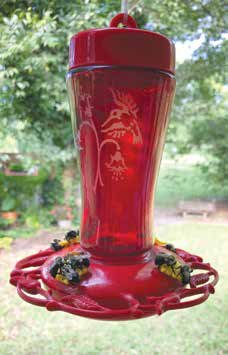
You can buy the liquid feed pre-mixed or you can make your own feed by mixing one-part sugar with four parts boiling water. The boiling water helps dissolve the sugar and removes impurities. Let the solution cool before pouring it into the feeder. A combination of colorful flowers and feeders work well to attract hummingbirds. Hang the feeders where birds can access them from all sides. Ants and bees are attracted to the sweet nectar in feeders. One useful tip is to apply vegetable oil on the wire or line holding the feeder. You can purchase feeders equipped with bee guards or an ant moat. This will help prevent ants from climbing down to the feeder or bees from taking over the feeding outlets.
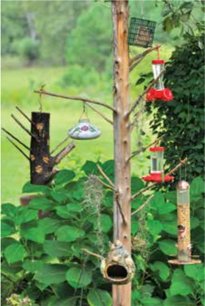
Hummers cannot walk due to the development of their legs and feet. They spend as much as two-thirds of their time on a perch. To attract hummers, leave small stems or limbs standing near your feeders. You can also attach a small limb to the feeders. This provides the birds a convenient place to perch between feedings.
Hummingbird Facts
Hummingbirds, or hummers, can only be found in the western hemisphere and are native to the Americas, particularly South America. There are 50 species that live and breed in Mexico while only eight species breed in the United States. These little birds are largely associated with warm, tropical climates but three species are common to Canada and, when migrating, certain species can be found as far north as Alaska.
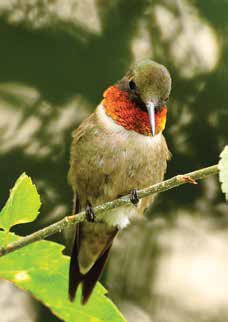
Hummingbirds are the smallest birds in the world. The average ruby throated hummer is 3 1/2 inches long and weighs 1/8th of an ounce. Males have an emerald green back, iridescent ruby-red throat that may appear black in some lighting, grey flanks, forked tail with no white and are smaller than the female. The female has an emerald green back, white breast and throat and a rounded tail with white tips.
Hummingbirds are like a feathered helicopter. They can hover, fly straight up and down, sideways, backwards and even upside down. They are the only birds that can hover in flight. Their wings rotate from the shoulder instead of the wrist, so they get power from both the upbeat and the downbeat. Their average flight speed is 27 miles per hour, though they can travel up to 50 miles per hour, with their wings beating 70-80 times per second.
These beautiful little birds have an incredible metabolism that requires 6 to 8 feedings per hour. Their heartbeat ranges from 250 beats per minute while resting to 1200 beats per minute while feeding.
Hummingbirds are very territorial. Many times, when one starts using a feeder, others will follow. Males will set up territories around a feeder and defend it, not allowing other hummers to use it. The aerial combat that follows is exciting to watch. If the combat gets too intense put another feeder up on the other side of your yard.
Hummingbirds need to feed on average 7 times per hour for 30 to 60 seconds each feeding. A hummingbird can eat from 1/2 to 8 times its body weight in a single day. They visit an average of 1000 flowers per day for nectar and play a huge role in plant pollination.
Pollination occurs when hummingbirds visit flowering plants. Tiny grains of pollen on the bird’s head or beak come in contact with reproductive parts of flowers. Pollen is also distributed by the movement of air caused by the rapid beat of the hummingbird’s wings.
Hummingbirds cannot feed at night so their metabolism slows down to a hibernation-like state called torpor. In this state, a hummer’s metabolic rate is 1/15th the rate of normal sleep and conserves up to 60% of the bird’s available energy. During night-time, torpor body temperature drops from 104 to 64.4 degrees Fahrenheit. Heart beat and respiration rates decrease dramatically in order to preserve energy but, despite the specialized efforts, as much as 10% of body weight can be lost in a single night.
Hummingbirds are very vulnerable during their first year of life, especially between hatching and fledging. Those that survive the first year can occasionally live for a decade or more but the average lifespan is probably between 3-5 years. The oldest known ruby-throated hummingbird was just over 9 years of age. The vast majority of hummingbirds over 7 years old are females. Males seldom live beyond 5 years. It is speculated that the rigors of migration and defending territories cause excessive weight loss which leads to death. The longest documented lifespan was a female broad-tailed hummingbird that was banded at one year of age and captured 11 years later, making her at least 12 years old.
Hummingbirds are vulnerable to a variety of predators, especially predators who focus on insects. Small raptors such as merlins and American kestrels, domestic cats, lizards and snakes all prey on hummingbirds. Successful attacks usually occur when the hummer is perched or distracted by foraging or breeding. Only swift, very nimble predators are able to catch a free flying hummingbird.
Reproduction
One interesting fact about hummingbirds, ruby throated hummers in particular, is they migrate. Many winter in South America and fly across the Gulf of Mexico, in some cases as much as 500 miles to reach their breeding grounds. This trip across the Gulf of Mexico normally takes around 20 hours. Studies have shown that healthy hummingbirds are capable of migrating over 1350 miles without a break.
The reason for migration is not fully understood but some believe they follow the migration of insects or the natural cycle of flower populations. Whatever the reason, hummingbirds prepare for the journey by fattening themselves, gaining as much as an additional 40% of their natural body weight.
Each bird travels alone although they follow the same route as other migrating hummers. This helps them avoid predators and find enough food to sustain them during the journey. Migration occurs in spring and fall.
Males arrive first and establish a territory. When the females arrive and enter a male’s territory, the male courts them with dazzling aerial dives to either side of the female. If the female perches, the male performs rapid horizontal arcs less than 2 feet in front of her. If she is receptive the female may give a call and assume a position with her tail feathers cocked and wings drooped. They do not form breeding pairs and the male leaves immediately after breeding, leaving the female to provide all parental care.
The female lays two white, pea-sized eggs in a nest the size of a walnut. The nest is constructed on a foundation of bud scales and attached to a tree limb with spider silk. Lichens camouflage the outside of the nest while the inside is lined with cattail or thistle down. Nests are flexible and able to expand as baby birds grow.

Eggs are incubated 12-14 days before they hatch. The female feeds the chicks 1-3 times per hour by regurgitating protein-rich arthropods and insects directly into the chick’s craw. Nectar alone is not sufficient for development of baby hummingbirds. Chicks fledge 18 to 22 days after hatching and the female will continue feeding them for another 10 days. The male takes no part in nesting or rearing of young.
Conservation Status
In the past, hummingbirds were hunted for their beautiful iridescent feathers which were used for women’s clothing and hats. In some cases, whole, stuffed birds were used as broaches or hat decorations. These practices have long passed and hummingbirds are rarely hunted today.
The greatest risk facing hummingbirds now is the loss of natural habitat. Some species of hummingbirds require mature tropical forests and these birds face a rapidly decreasing landscape due to deforestation and the creation of new agricultural land in tropical countries.
Today, hummingbirds are regarded as a pleasant addition to gardens and other places that are frequented by people. The presence of these beautiful birds has encouraged the planting of nectar-rich flowers that hummingbirds favor. The fact that some species are attracted and benefited by feeders and artificial nectar has also improved the population status of those species.
This type of management will only benefit species that frequent open, disturbed habitat. The many species that live and breed in forests can only be sustained by the conservation of large tracts of that ecosystem type.
Close
Hummingbirds are all energy and fun. They are easy to attract and hold in a given area with little effort and provide more than enough entertainment to justify the small amount of effort it takes to have them around.